Saturday, 17 April 2010

The Road Home


This is a gentle yet powerful tale from Zhang Yimou. I'm going to say very little about the story as you need to watch it unfold for yourself. The central themes are of love, commitment, patience, hope and a valuing of the old ways. The story is also strongly political and challenges the Communist Party Dogma with good old common sense.

The acting performances from Zhang Ziyi and Sun Honglei are very strong and believable. There are many cultural references that Western viewers will miss, but that won't detract from the benefit of watching this film. It is a story that invites you to place yourself within it and ask how you might respond. The potential for a tear to well up comes at several stages - particularly so as the film reaches its climax. The landscape and setting is mesmerising. the sense of collective community is portrayed as adding strength to the village the story is set in.

Get hold of a copy of this DVD and you won't be disappointed. I'll give it 8/10.

Paris Texas


A Road movie.

A man dressed in a pin-striped suit, tie and baseball cap walks across the desert of Southern Texas. He is out of water and his only companion is an Eagle watching him from a lofty peak. He ends up in a local clinic and whilst being examined says nothing. The Doctor finds a name an address in the mans wallet and calls it. It is the man's brother - Walt. Walt lives in LA with his French wife Anne and immediate resolves to fly to Texas and bring his brother home.

Eventually Walt arrives at the clinic only to be told his brother Travis has left on foot. We see Travis walking in a straight line across the brush and scrub.This happens repeatedly - and all without Travis uttering a word. Walt finds this odd and frustrating - particularly as they have heard nothing from Travis for four years and Travis' son, Hunter, is living with Walt and Anne. Eventually they arrive at the airport to fly back to LA but as the plane taxis toward the run way it stops and Walt and Travis get out - Travis refuses to fly. A two day road trip follows but as soon as Travis takes the wheel and Walt drops off to sleep, Travis heads for Paris, Texas. Travis believes, based on a story from his father, that he was conceived in Paris, Texas. He clutches a photo of a vacant lot he had bought some years earlier in Paris and wants to locate it. He intended to build the family home on it and raise his son. Slowly Travis begins to speak and more and mor eof the story unfolds.

 The pace of the first 90 minutes is extremely slow - painfully slow, but it speeds up. In LA Hunter is introduced to his biological father and very slowly a relationship develops. Then all of a sudden Travis invites Hunter to go with him in search of his mother. He agrees and off they head to Dallas armed only with the knowledge that Jane (Hunter's mother) makes a deposit at a particular bank on the 5th of each month. They keep the bank under surveillance and Hunter spots his mother from an old photograph. Travis and Hunter follow her to a sex joint where punters pay to talk to girls through a two way mirror while they presumably perform the fantasies of the client. Travis goes in and at the first attempt is unable to say much to her. He returns having left a full 'confession' on tape for Hunter to listen to. At the sex joint, He begins telling a story in the third person explaining how he managed to allow his marriage to break down. He can't bring himself to look at Jane as he does this and pointedly sits with his back to the mirror. Eventually, she realises that it is Travis and she confesses her part in the breakdown.Travis tells her that Hunter wants to see and the film ends (after 2.5 hours) with a warm encounter between Hunter and Jane in a downtown hotel. Satisfied that son and mother are reunited, Travis drives off. End of film.

Apart from the length and lack of pace, there is much to commend this film.The way in which it portrays the human propensity to screw up vital relationships has an honesty about it. The fact that the film didn't have a sugary ending (unlike Bagdad Cafe) is to be commended. The breakdown in relationship obviously screwed Travis' mind, but he had processed sufficient data and emotion over the four years to resolve to find his plot of land in Paris. How stable is Travis? He relates that his father had a mental illness - is he similarly afflicted? What life did Travis have before he met Jane and after the reconciliation? How could Hunter be expected to cope with 'here's your dad', 'you're leaving Walt and Anne', 'here's your mom' 'bye bye I'm gone' in such rapid succession with no support? The film leaves more questions than it gives answers - whihc is what endears it to me. What happened to Walt & Anne afterwards?

What possible metaphors might the story contain? Perhaps Travis' reluctance to fly and miss the journey back to LA is a statement about having to make the journey - traveling is more important than the destination.There is a lot of use of phones, walkie-talkies, a walkman and mirrors to protect people from delivering intimate and painful dialogue face-to-face.Does the empty lot on Paris show a picture of Travis' need to return to the dust of his creation to be recreated?

All in all, there is much love but also much guilt on show in this film. I imagine that it's a sign of this broken creation that the two have to go hand-in-hand, This film is worth the effort - but get an extra large box of popcorn - you'll need for the first hour and a half!
I'll give it 7/10.

Bagdad Cafe


The unrelenting sun and constant dusty wind create an inhospitable place that appears to be detached and isolated from anywhere else. A Bavarian husband and wife – in full Alpine regalia have a falling out at a remote picnic place. She opts to walk and he drives off never to be seen again. Off trudges Jasmin, dragging her overfull suitcase behind her along the dusty and empty road. Eventually she comes across the Bagdad Cafe oil and gas station and motel.

Just prior to her arrival we are introduced to the characters at the cafe. The Cafe is run by Brenda and her laid back and easy-­going husband. They quarrel and the volatile Brenda's chiding drives the husband away – he leaves. Brenda is left with her son who only wants to practice Bach on the piano, his six month old baby who is brought up by everyone, her daughter who is more interested in men than school and the bar tender/cook. Mr Cox, an ageing Hollywood has-­been lives in a caravan at the motel and a tattoo artist runs her business from a room on the motel – but the suggestion is truckers get more than an tattoo when they visit her!

In the distance are a rail-road and a busy freeway, both presumably carrying the traffic that used to pass the Bagdad Cafe which appears to have very few customers. This is the dysfunctional and bleak situation that Jasmin walks into. The well-­to-­do and immaculate appearance of Jasmin strikes a stark contrast with the dusty, dishevelled and dysfunctional cafe and motel. Brenda is suspicious of a German woman walking out of the desert and takes an instant dislike to Jasmin. Jasmin pays for a room for the night and trudges off to the motel block to find her room. It is then that she discovers she has taken her husband's case containing his clothes and a magic set – presumably a souvenir from Las Vegas.

The following morning when Brenda is cleaning Jasmin's room, she is shocked to discover men's clothing hanging up everywhere and shaving equipment set out in the bathroom. Her suspicions heightened, she calls the local Sheriff and asks him to investigate. The Sheriff arrives and checks Jasmin's passport and return ticket and discovers that hey are in order. Over the course of the following days, Jasmin works her way into the affections of the residents and becomes accepted by everyone – except Brenda. Jasmin helps with the cleaning, child-­minding and other chores but goes too far with Brenda when she cleans and tidies the chaotic and filthy motel office while Brenda is on a trip into town. Brenda orders the rubbish to be returned and while Jasmin unpacks it, Brenda comes to her senses and accepts Jasmin's gesture.

All the while, Jasmin has been learning magic tricks and tries some on the few customers of the cafe. Discovering she is good at it, she develops her craft and combines this with waiting at table in the cafe. Truckers spread the word and soon the cafe is bursting to its seams every day.

Jasmin has worked her magic and through it transformed the community that centres its life at the cafe. The Sheriff stops by and on discovering Jasmin still there informs her that her visa has expired and that she must leave. The cafe returns to its past moribund state and one of the characters observes that “the magic is gone”.

Then one day Jasmin returns and life and energy is restored to the Bagdad Cafe and the truckers return in their droves. Brenda and her husband are reconciled and everyone lives happily ever after.

This is an odd film that you need to let wash over you. Too much critical analysis and the patchy acting, lumpy dialogue and fantasy elements of the film become too apparent. Did the schalmzy ending spoil it – yes I think so. That the power of transformation is dependent on Jasmin's presence is paramount. The musical fantasy number at the end belongs to a different era – and probably a different film.

Is it worth watching – yes it is. The film is a story about transformation and redemption – a 'Christ-­movie' in that sense. Not the strongest of the genre, but an interesting and off-­beat film.

I'll give it 6/10.

Friday, 16 April 2010

Annual Muswell Hill Film Weekend


Today sees the annual Muswell Hill Film Weekend in North London. Originally started by Vic Thiessen, former Director of the London Mennonite Centre, this weekend explores five different films which folk then reflect on and critique. Rather than being pointedly theological, the reflection is more on the lines of what are these films saying about the human condition - which is I guess a kind of theological reflection.

Sadly Vic has been recalled by his denomination to other responsibilities and the weekend will be run by a capable group of folk from the London area who have used this annual event as inspiration to run their own monthly series of gatherings. Vic used to ensure a little intellectual rigour made a contribution by inviting the presenting of a couple of papers, but this year this has gone by the wayside in favour of a quiz. Also, we never knew what we were watching until it began and mostly they were films folk hadn't seen. This year the films have been democratically chosen and I've seen 3/5 - indeed two were my nominations and I'm having to bring the discs for us to watch!

Let's see how it compares to the previous style. A big thanks to the London group for organising it and to Hazel for all that she has done. Here's the programme:

Friday night       -  Bagdad Cafe

Sat morning      -   Paris, Texas

Sat afternoon    -  The Road Home

Sat evening      -   Angel-A

Sun morning      -  The Lemon Tree


If this is the kind of activity you feel you might be interested in, other places that hold regular similar events are:
  • Greenbelt - Christian Arts Festival last weekend in August at Cheltenham Race Course
  • St Deiniol's near Chester:
    • Each April a Film & Theology weekend
    • Each November a mid-week exploration of films of Faith & Doubt
I shall be leading my own three day exploration of films of Faith & Doubt 29 Nov - 1 Dec in Hampshire. If you want details, let me know.

I'll let you know how the weekend went.

Thursday, 15 April 2010

Kick Ass


I wasn't sure what to expect when I went to see this yesterday. My son raved about it and so did some colleagues who had seen it. So I guess I went with high expectations. I must say that I feel disappointed at the outcome.

WARNING: PLOT SPOILER

The story is set in an anonymous suburb of New York where Dave Lizewski attends High School and hangs out with his two friends, Marty and Todd - all three of them unremarkable in every way. The interest they have in common - apart from girls - is Super Hero comics. They are portrayed as three teenagers coming to terms with hormone soup coursing through their veins. Dave has the hots for Katie who appears to have the hots for Erika and so appears to be off-limits to boys. She develops a friendship with Dave because she believes the rumour that he is gay and so it is safe to hang out with him - especially in her bedroom where he gets to rub on an all-over body tan! The way in which the film deals with teenage sexual angst is really very good. This was for me the highlight of the film!

The main thrust of the story concerns Dave's wish to be a somebody, and in his case to be a somebody driven by a morality that challenges wrongs and promotes well-being through tackling crime - typical Super Hero stuff. So Dave decides to become a Super Hero - Kick Ass. His first foray into crime fighting sees him seriously done over by a couple of local thugs who stab him. He is then run over. His hospital x-rays show virtually all his bones to be held together with pins and plates and that together with most of his nerve endings having been trashed by injury/surgery means he has hardly any feeling. He has been rebuilt and has an extremely high pain threshold. Good qualities for a Super Hero to possess. His early exploits get captured on CCTV and mobile phone cameras and he becomes an overnight sensation spawning a merchandising boom. Marty and Todd, not to mention Katie, are in awe of this Super Hero and this fills Dave with much pride.

The plot is quite involved. A former police officer was framed as a drug dealer and did time. He didn't see the birth of his daughter or the death of his wife and blames drug baron Frank D'Amico for this. Kick Ass, who has no fighting skills or special powers meets Big Daddy, the former cop who, in his quest to bring down an evil drug baron D'Amico, has trained his 11 year-old daughter to be the ruthless vigilante Hit Girl. They team up together and the noose tightens on D'Amico.

D'Amico's 17 year-old son Chris is frustrated at not being permitted to join his father's 'business' and so hatches a plan to entrap Kick Ass and Big Daddy by posing as the Super Hero Red Mist, thereby proving to his father he is ready to step up to the plate. The trap is sprung and eventually Hit Girl is shot and Big Daddy and Kick Ass captured. Their captors plan a live unmasking over the internet which all the TV channels stream live. It turns nasty and it become clear that this going to be an assassination attempt. Hit Girl was saved by her bullet-proof vest and comes to the rescue, but sadly not in time to save her father. She them teams up with Kick Ass to find and kill Frank D'Amico and avenge the death of her parents at his hands.

The violence - and there is a lot of it - is of a choreographed nature similar to The Matrix and Kill Bill. It also draws heavily on the film's comic book roots, but it is made to look real enough rather than virtual or disguised as art. But more than the amount and nature of the killings that happen, it is that by far the Lion's share are down to Hit Girl who is only 11 years old and additionally uses some pretty ripe language which pulled me up short. This is disturbing.  It is plainly wrong to portray an 11 year-old as a trained assassin whose motivation is revenge and retribution. For me this comprehensively soured the whole experience. Hence my disappointment.

Don't go and see it - save your money and see something more worthwhile. I'm not even going to give a rating to this film.

And please don't call me hypocritical for justifying the violence in Girl with the Dragon Tattoo whilst vilifying it here. Context is everything. Violence is indiscriminate but when story-writers choose to put automatic weapons in the hands of children and turn them into assassins, they have lost touch with the things that really matter.

Monday, 12 April 2010

The Bank Job


A gripping story set in the early 1970's - ripe with nostalgia, a great story and engaging acting. This is the ultimate small-time villain given the chance to go big-time movie. The plot is complicated but unfolds beautifully as the narrative of the film plays out. There is lots of tension throughout. Can the little boys cut it with the big boys and what will MI5 do? Will the bent police rule the day or will the rule of law be upheld?

It might seem an odd suggestion, but the story has a very strong morality running through it. There are definite rules and when these are broken retribution is swift. There is betrayal, but also trust. There is suspicion of adultery, but true love wins through to forgive and move on. Gripping and fascinating.

Based on a true story, an unlikely team of small-time villains are brought together to do the Secret Service's dirty work and protect the Royal Family from scandal. They bite off more than they can chew and end up taking on porn barons, Caribbean drugs traffickers and bent coppers.

I'm not going to say any more as it will spoil it for those who haven't yet seen it. It's enjoyable - particularly to see 'Poirot' (David Suchet) playing a very unsavoury and detestable character.  Available in the UK on DVD for £4 or less - well worth the investment.

I'll give it 8/10

Saturday, 10 April 2010

Brief Encounter


Sixty Five years old and still a classic! This David Lean and Noel Coward joint project is a masterpiece of cinema. The concept is so simple, the acting as tight as the many closely framed shots, the sets and dramatic lighting reinforce the story.

As much as anything else, the film presents a wonderful social record of middle-class England in the 1940's. Although made in 1945 with WWII still raging, there is no direct mention of the war or it's impact - nothing is on ration and luxury goods seem widely available. Perhaps part of the film's task was to paint a propaganda picture of 'business as usual'.

Laura has a loving, if undemonstrative husband and two children. Every Thursday she takes the train to Milford to shop. She lunches and goes to the cinema, returning home in time to change for dinner with the children in bed and the meal prepared by the maid. Evening excitement is provided by listening to music on the wireless while she sews and her husband completes the Times crossword. A picture of living the middle-class dream? Affirming commentary for the middle-classes as it confirms their station in life, gratifying for the upper-class as it underlines their superiority and aspirational for the working class as they crave status and a comfortable life.

Much of the story unfolds in the Tea Room at Milford Junction station. One day, a passing Express Train whips up a dust cloud and Laura gets a lump of grit caught in her eye. She enters the Tea Room and asks for a glass of water to wash out her eye, but this does not succeed. Thankfully a fellow traveller who is Doctor is on hand to remove the offending grit. This proves to be first contact and over the following Thursdays, the two meet each week initially to share lunch and the cinema. The relationship deepens and they fall in love. This falling in love is plainly seen as something that is not a critique of their current marital relationships as the Doctor - Alec, is also married with two children.

What gives the film its overwhelming sense of power is the sensitive way in which the infatuation of new love is captured and portrayed. Throughout the film we see nothing of Alec's family or domestic situation. As Laura returns home each week she finds herself having to tell white lies to begin with and these soon become black lies as she draws friends in to provide an alibi should the need arise. Throughout the film, Laura and Alec wrestle with the pressing urgency of their love for each other as it fights their sense of obligation to their family and their sense of responsibility and propriety.

There are delightful scenes of two people enjoying each others company - particularly the boating scene where they act like teenagers. Once or twice the demonstration of love presses to go beyond a hurried kiss when no-one else is looking, almost making it when Alec has access to a colleagues flat, but the colleague returns unexpectedly early. Throughout the film it is Alec who is seemingly taking the lead, prepared to give words to the feelings he has and is sure that Laura shares. At each stage Laura responds but as she does the flaming arrows of love turn into spears of guilt which pierce her heart and bring to mind her husband and children.

As the relationship between Laura and Alec unfolds, so the flirting between the ticket collector and the pretentious lady who runs the Tea Shop, provides a vulgar and more coarse parallel. This seeks to more clearly underline the differences in social class.

Most of the story is told in flash-back as Laura sits traumatised at home with Rachmaninov booming out on the wireless. Her husband oblivious to the mental and emotional angst that Laura is processing. It is a simple story, amazingly well told and with superb acting. As social commentary it is priceless - my parents would have been in their late teens when this was made. As drama it is top class. As a portrayal of what it means to be human and in love with all the highs and lows that accompany that, it is possibly unequalled within the canon of cinema.

I purposely haven't told you the ending - on the off-chance that you haven't seen it. It's an amazing watch that would be completely spoiled by technicolour! It's available in a digitally remastered DVD edition in the UK for an amazing £3.99 at the moment. This should be in your DVD library - go get it.

I'll give it 8.5/10.

Tuesday, 6 April 2010

Blind Chance


This is billed as one of Kieslowski's best films. I would beg to differ. The first 60 minutes is hard to keep up with. No doubt to a Polish speaker it is resonant with nuances and subtleties from the oppressive communist era and the growing movement for democratic freedom. The subtitles are sparse and it it is evident that far more is being said than is being shown in the subtitles.

Witek is a medical student. The first 30 minutes of the film establish his family set-up and the context. Witek decides to take a break from his studies because the vocation is no longer there. We then see him running for a train which he just manges to catch. He goes on to become a member of The Party and that story plays out that outcome. On the hour mark, we see him running for the same train and a guard stops him as he hurtles down the platform in pursuit of the departing train. The ensuing skirmish results in the Police being called and Witek is found guilty of his crime. This pushes him into contact with underground political opposition and an opposite story is told to the first one. After another 30 minutes we are back to the station and Witek runs after the train but fails to catch it. On the platform is a fellow medical student who was waiting for him. They develop a relationship, marry, and Witek resumes his studies and becomes a successful research Doctor.

One story - three outcomes.

An interesting film, but hard work. Not as good as Trois Couleurs, or Heaven, or Hell .....

I'll give it 6/10.

Sunday, 4 April 2010

The Hangover

My daughter's choice of viewing this evening. This movie is well suited to the teen audience it aims at. A kind of Wayne's World for the current teen generation. Sadly that means that most of the storyline and dialogue are predictable, but my daughter was engaged by, and engrossed in, this film - and that's not the first time she's seen it.

Three guys take their best friend to Las Vegas for a stag night. In a well-intentioned attempt to add bon vivant, they imbibe Roofie instead of ecstasy. As the three friends wake up on the morning of the night before, they discover their $4200 a night suite is trashed. There are chickens clucking around, there is a Tiger in the bathroom and a baby in the cupboard - but their friend is nowhere to be seen. They are extremely hungover and can't remember a thing about what happened the night before and where their friend might be. So they work their way around Las Vegas encountering the Police, hospitals, Mike Tyson and the underworld as they try to work out what happened.

The wedding always looks in jeopardy - I'll leave you to discover the outcome.

An okay film for light laughs with some good characterisation. I'll give it 6/10.

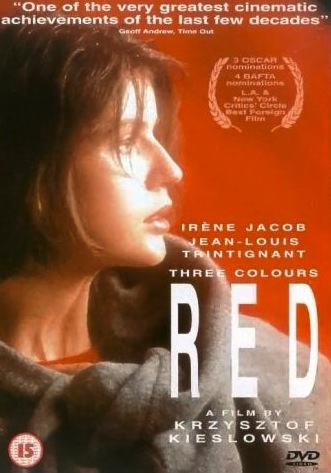
Trois Couleurs - Rouge / Three colours Red


A fascinating film. An examination of relationships, of truth, of motivation for living and of social responsibility - oh, and a lot things coloured red! Set in Geneva and focussing on Valentine, a student and part-time model. The film revolves around Valentine's relationships and the relationships of those around her as it explores different dynamics of relationship and social interaction.

Valentine poses for a poster to promote chewing gum and a 65' wide picture of her in profile adorns the city streets. She seems unfazed by her new notoriety as she desperately tries to cajole her reluctant and at the same time obsessive boyfriend Michel into a closer a relationship. The film opens with the viewer being taken down the phone lines and under the sea to emerge in a handset as an international call between the two connects between Geneva and London. Phones are central to the telling of the story - they are used in an allegorical way to depict how people communicate - or choose not to, or choose to do so on an other frequency.

Valentine runs over a dog by accident and tracks down the owner - a retired Judge who is extremely bitter and cynical and who is not at all interested in the dog or its fate. She takes it to a vet where the wounds are dressed and a good prognosis is announced - along with the news that the dog is pregnant. Valentine takes the dog home but it soon runs off when let off the leash in a local park. It is tracked down at the original owners. Valentine has received FFr 600 in the post and suspects the owner of sending it. Valentine hands the money back saying that the vet's bill was only FFr 130. The Judge gives a FFr 100 note from the bundle and wonders inside to find the additinal FFr 30. He is gone a long time and Valentine enters his home in search of him only to discover that he is listening in on all his neighbours phone calls. She is shocked and disgusted and tells the Judge to stop it. She cannot bear to listen to the conversation currently under way when two men talk about their liaison the previous day and how one of them the Judge's neighbour, wants more. The Judge points out the house where the call is coming from and Valentine resolutely heads off to confront the husband. she is met by the man's devoted and hospitable wife and she waits for the man to finish his call upstairs she notices the man's daughter listening in on an extension. Valentine tells the wife she has the wrong house and leaves hurriedly.

Whilst visiting the Judge, Valentine also overhears a conversation between Karin and Auguste (her neighbour), where they discuss if they should go bowling. Valentine covers her ears, but from the very little she heard she concludes that they love each other. The Judge takes an opposing view. That evening Valentine is alone at home and hopes that Michel would call but it is the photographer who calls, saying that her poster was set up that evening and asks her bowling to celebrate. She goes and ends up unknowingly bowling only a few alleys away from Karin and Auguste as she is unable to make the connection to the conversation she part overheard. In the bowling alley we see a broken beer glass. Broken glass is another recurring allegorical picture of the fractured, shattered and sharp relationships that make up this story.

From the newspaper, Valentine reads that the Judge wrote to his neighbours and the Police admitting what he had been doing and was consequently up in court against his neighbours in a class action. On their next meeting, Valentine and the Judge continue their philosophical conversations about pity, disgust, trust, relationships, destiny, guilt, remorse, punishment and a whole lot more.  The judge suggests that being in a position of deciding what is truth and what is not displays a lack of modesty and vanity on behalf of humanity.

Valentine buys a ferry ticket so that she can visit Michel in England. That night she is taking part in a fashion show as catwalk model and invites the Judge. For the first time he makes himself look presentable and enjoys the evening. Afterwards, against the backdrop of an ominous thunder-storm, the couple talk and the Judge begins to share some of his story. It is clear that the couple are growing closer and Valentine's caring, compassionate but troubled nature and the Judge's tendency to play God strike and discordant note to begin with. However as the narrative unfolds, the relationship between the two is always electrifying and as time and conversation, reflection and a coming to terms with reality, brings them closer, there is real warmth and the development of mutual respect and admiration.

The film ends with breaking news on the TV of a ferry disaster in the English Channel. With nearly 1500 people on board, only seven survivors are pulled from the sea: the main characters from the first two films of the trilogy, Julie and Olivier from Blue, Karol and Dominique from White, Valentine and Auguste, who meet for the first time, as well as an English bartender named Stephen Killian. The film's final image shows the chewing-gum poster image of Valentine in stunning profile against a billowing red sheet.

As mentioned in my review of Bleu, Roger Ebert describes the trilogy "as an anti-romance, in parallel with Blue being an anti-tragedy and White being an anti-comedy." I think this is a much better way of analysing a linking theme - it is much easier than trying to read Liberty, Fraternity and Equality into it! Another recurring image related to the spirit of the film is that of elderly people recycling bottles; in the case of Rouge an old woman cannot reach the hole of the container and Valentine helps her (in the spirit of fraternity [sic] underlying the film?). In Bleu, an old woman in Paris is recycling bottles and Julie does not notice her (in the spirit of liberty?); in Blanc, an old man also in Paris is trying to recycle a bottle but cannot reach the container and Karol looks at him with a grin on his face (in the spirit of equality?).

Another excellent piece of work from Krzysztof Kieślowski. The whole trilogy is well worth a watch. My favourite is Bleu.

I'll give this one 7.5/10.

Friday, 2 April 2010

Up


I know it shouldn't by now, but one thing that repeatedly startles me is the power of story to move the hearer and evoke an affective response. This film is an animation and whilst children enjoy watching it, it operates on different levels to great effect. I was left with tears rolling down my face on a number of occasions. Perhaps a fitting condition to be in on Good Friday?

The plot is simple enough. Carl and Ellie are kids who are fascinated with exploration and the explorer Charles Muntz who returns to Paradise Falls in Venezuela to catpure zoological specimens to prove the veracity of his reports of his previous visit to the region. Ellie is outgoing and gregarious and Carl is quiet - he doesn't talk much. They act out their exploration fantasies in a derelict house. Their friendship turns into love and they marry. They move into the derelict house and renovate it.

Both work in the zoo - Carl is a balloon seller. As it was in childhood, so it is in adulthood - they plan and plot their adventures of exploration. Themes of promise and commitment - of covenant - run throughout this film. An echo of Abraham and the Old Testament. As they grow old together there is always a tinge of sadness in that they were not able to have children. (Another Abrahamic echo?) In old age, they finally manage to save enough to allow Carl to fulfil his promise and buy tickets for them to travel to Venezuela to visit Paradise Falls but Ellie becomes ill and dies. Carl become even more reclusive and more sour. Skyscrapers now tower over the house which once stood in a quiet residential street. The developers put pressure on Carl to sell up so that they can develop the land his house stands on. He remains resolute.

A dispute with one of the developers following the accidental demolition of his mail box provokes Carl into a spur-of-the-moment physical assault. The resulting summons and court determination sees him consigned to a retirement community. As the men from the community come to pick him up he tells them to wait in the van while he says his final good-byes. It is then that Carl enacts his plan to honour his promise to Ellie and with thousands of brightly coloured helium-filled balloons tethered to the house it breaks free from its foundations and floats away. Russell, a Wilderness Explorer who needs to earn his final merit badge for "Assisting the Elderly", has stowed away on the porch after being sent on a 'snipe hunt' by Carl the day before.

Needless to say that Carl and Russell navigate their way to Paradise Falls where they have many adventures as Carl resolutely drags the levitating house step-by-step toward the Falls to position it next to them. On their adventures they discover forgotten creatures akin to Conan-Doyle's Lost World. They also discover Muntz who is so focussed on capturing Russell's new friend, a large rainbow-coloured bird called Kevin, as the exhibit that will clinch the clearing of his name, that this brings him into conflict with Carl.

I won't spoil the ending for you. This is a story so full of moral fibre that it oozes engagement that demands the viewer carry out an inventory of their relationships, priorities and outstanding. commitments. Again, very fitting for Good Friday.

The animation is excellent. They have obviously now perfected the technique of rendering woven fabric in a way that displays the pattern and texture of the weave - as every object that could conceivably be shown in this way, was!

I'll give this a 7.5/10. Go watch it.

Sunday, 28 March 2010

Trois couleurs: Blanc / Three Colours White


The second in the trilogy deals with the subject of equality and presents us with a black comedy. Although the film starts in Paris, most of it is set in Poland.There is both a light-hearted and also darker more sinister quality about "White". In his review of the trilogy, Rober Ebert interprets this film as an anti-comedy, in parallel with Blue being an anti-tragedy and Red being an anti-romance. An interesting and plausible concept. As with Blue, the colour white is used to reinforce concepts of the story-line. The achievement of orgasm, the arrival home in Poland. It is also interesting to note that Julie from Bleu tries to enter the courtroom as the main characters case is being heard. In Blue, we see this from the other side of the door. Elderly people recycling bottles also seems to be a theme - I'll try to pick that up in my review of Red when I get there!

Karol is a Polish hairdresser - an inconspicuous and anonymous looking man who lacks self-esteem. He has however married the beautiful but cold-hearted Dominique who because she is less than satisfied with Karol's performance in bed (what is it with the French?), she divorces him. This leaves him homeless, penniless and hopeless.

He meets Mikolaj - a fellow Pole - on the underground platform as Karol is busking, playing the comb and paper. The pair strike up a conversation. Throughout the film when a light-hearted moment is shown, a dark overtone is also present. For example, when Karol tells Mikolaj of his beautiful wife, he voyeuristically points her silhouette out through an apartment window, only to discover upon phoning her, that she is in bed with another man - she puts the phone to her mouth and moans as loudly as she can to emphasise Karol's failure.

Through extremely comedic circumstances Karol returns to his former home in Poland with his brother. Karol resolves to change his circumstances and rather than cutting hair works for a local wide-boy engaged in scams and sharp deals. By tricking this guy, Karol buys up land that he wants to buy as he knows a developer wants to build there and the price will rocket. Coming close being killed, Karol makes enough money to set up in business and invites Mikolaj to become his partner. Together they operate a very successful import/export business and Karol becomes very wealthy.

Karol then plots to stage his own death by buying a corpse from a Russian trucker - you can buy anything Mikolaj tells him. Having changed his will so that his considerable wealth goes to his ex-wife, he then stages his funeral which of course Dominique attends. Karol watches on (to maintain the voyeurism motif) as Dominique cries at his grave-side.

As Dominique returns to her hotel she gets a shock to find Karol sitting up in bed waiting for her. After he has convinced that he is alive they then make love and Karol takes Dominique to places he's not taken her before. He gets up and leaves before she awakes and leaves to catch a plane to Hong Kong with a new false identity.

Dominique receives a visit from the Polish police who have received an anonymous tip-off (from Mikolaj) that Karol died in suspicious circumstances. Dominique of course protests that Karol is not dead but Mikolaj and Karol's driver both identify 'his' exhumed body and so Dominique is made to look both a liar and a fool.

Karol has made his millions and so proved he is more than an equal for Dominique. He has successfully made love to her in a more than satisfactory way. He plans to live a life of luxury on the other side of the world with a new identity and Dominique is under police suspicion. Game set and match? Not quite. The climax of the film sees Karol visiting the jail where Dominique is being held. Through her cell window, Dominique uses sign language to communicate with Karol. She tells him that she still loves him and is willing to marry him again, if she can get out of prison. Karol begins to cry, realizing that he too, despite achieving 'equality' with his ex-wife, still loves her. He has succeeded - but the victory comes at an immense price for Karol.

This is a masterfully crafted piece of story-telling and whilst not as engaging as Blue, it is well worth the watch. Can't wait to see what Red is about! 

I'll give this 7/10.

Friday, 26 March 2010

Trois couleurs: Bleu / Three Colours Blue


Bathed in hues of deep blue which reinforce Julie's desolation and depression, this story is an exploration of the emotions of grief and the rebuilding of life after bereavement. Juliette Binoche's performance as the musically gifted Julie is as powerful as it is nuanced and subtle. The way in which she physically embodies grief and then seeks to expunge all reminders of her husband and daughter following their tragic and brutal death in a car crash, draws the viewer in and engages the emotions in a compelling way.

From her attempted overdose as she recovers in hospital to the stripping and abandonment of the family country mansion, you are always wondering if she is going to teeter over the brink and into psychosis and an ever deepening downward spiral.

Her attempt to withdraw from her former existence and begin anew, unknown to everyone, succeeds to begin with. However, some from her old life, as well as new acquaintances, slowly begin to demand things from her as they demonstrate their need of her and their commitment to engage with her and make themselves vulnerable. Julie battles these tensions as she seeks to establish a new sense of self-identity. The turning point comes when she tracks down a manuscript that her husband was working on - a magnum opus - for the unification of 12 states in Europe to be played simultaneously by 12 orchestras in the capital cities. It is the destruction of this manuscript that is the final act that frees her from her past.

In her new apartment in an old quarter in Paris, one of the other residents, Lucille, who works in a strip and sex club in Pigalle, is in need of Julie's support. The very fact that Julie responds is enough to give Lucille the encouragement she seeks. In the ensuing conversation Julie asks her why she does what she does. In response Lucille says "Because I like it." This seems to become a pivotal moment from which a new Julie begins to emerge - a Julie who gradually gets back in touch with emotions and her creativity and who, in a new way, begins to embrace life again.

Near the beginning of the film Julie turns to Olivier in her desolation in search of comfort. Olivier is a colleague of her husband whom she suspects has feelings for her which he freely admits to when asked directly. (It is worth noting that my wife feels Julie has been having an affair with Olivier.) It is with them both in his bed that the film ultimately ends. Another painful pin prick that awakens the emotions is the discovery by Julie that her husband has a mistress (what is it with the French?) who after the car accident discovers she is pregnant by him.

Julie never loses her humanity and consistently displays acts of kindness and compassion. She ensures her mother is taken care of in a very good nursing home and visits her periodically. Julie is frustrated that her mother believes her to be her mother's sister but accepts it as being down to her dementia.

This is the first film in Krzysztof Kieslowski's Trois Couleurs trilogy based on the French national flag and national motto Liberty, equality and fraternity. It explores the theme of liberty in Julie as she seeks an existence free from the emotional demands and ties of her past life. She seeks independence and an existence that is indebted to no-one and is devoid of the distractions of love, grief and other emotions.

It is a powerful enactment of story. I am looking forward to white and red!

I'll give it 8/10.

Thursday, 25 March 2010

The Diving Bell & The Butterfly


A touching and engaging story based on the true-life account of a French fashion magazine editor Jean-Dominique Bauby (Jean-Do) who suffered a massive stroke leaving his body paralysed - except for his left eye. He loved fast cars, the high life and the adulation that being a top fashion editor brought. To see a man so much at the top of his game vocationally, relationally and in terms of popular acclaim brutally cut down by the cruel arbitrariness of a stroke is a sobering encounter. He is estranged from Celine "the mother of his children", he obviously has other lovers. His children were devoted to him and in turn he was devoted to his father (Max Von Sydow popping up again - how many films has this man made?).

The senior consultant looking after Jean-Do has the bedside manner of an insensitive porcupine on a bad day. "I am in charge of your case and it is my job to tell you the bad news..." The team of nurses and therapists who care for Jean-Do show wonderful tenderness, love and commitment above and beyond the call of duty - especially his physiotherapist Marie and his speech therapist Henriette. Even though Jean-Do suffers the frustration of having 'Locked-in Syndrome' he manages to communicate by blinking when the correct letter is recited, enabling him to spell words. 

There is even room for humour on several occasions best exemplified when Josephine models how he should try to move his tongue and how he should try to blow her a kiss. In close-up this all looks too much like an invitation of another kind and poor Jean-Do can barely contain himself. 

Jean-Do refuses to give in and looks on his unresponsive body as a Diving Bell that imprisons him. The things that are not paralysed are his memories and his imagination - a Butterfly - which he manages to combine to great effect taking him on soaring journeys across  mountains and deserts. A recurring theme is the faith of those around him - particularly his daughter Celine and Marie. They along with many others, faithfully pray for Jean-Do's healing - a miracle. He remains unconvinced by the possibility of a miracle. 

When Josephine takes him to mass at the local church, she and the priest offer to take him to Lourdes which triggers memories of a past visit with a former lover for whom he bought a flashing statuette of the Blessed Virgin. Back in the hotel with Mary plugged in and brightly flashing, Jean-Do is unprepared to continue with the intimacies he was anticipating and the girl refuses to turn the flashing virgin off. Another great moment of ironic humour.

Before the stroke, Jean-Do had negotiated a publishing deal for a book - a version of the Count of Monte Cristo. He resolved to write a book dictating the text by the fluttering of his eye lid to a patient and attentive girl Claude, sent by the publisher. In his thoughts he tells us that a "text is not alive until it's read". Perhaps that helps to answer the question 'if a tree falls down in the middle of a wood and no-one is there to hear it does it still make a noise?'.

it is Celine who devotes her time and life to being with Jean-Do. She handles the incoming phone calls which Jean-Do listens to on speaker-phone and responds to by blinking through the special alphabet devised by Henriette which lists the letters in the order of the frequency of usage: ESARINTULOMDPCFBVHGJQZYXKW.

Jean-Do's book is published but he sadly dies 6 days later from pneumonia and complications.

This is a compelling story, well told and well acted. The ability to depict the Pas de Calais coastline as both warm an inviting and also cold and repelling to suit the mood of the story is masterfully done. To present the Marine Hospital of Berck-sur-Mer as an institution or warmth and humanity conveys a connection with Jean-Do's humanity that leaves viewers feeling they have been touched by the life that refuses to give in - a life that still has a contribution to make.

I recommend this film - get a copy if you can. I'll give it 7.5/10.

Tuesday, 23 March 2010

The Girl with the Dragon Tattoo - again


I liked this film so much - I'm going to see it again this afternoon!

Harbour Lights Southampton 14:10.

---§§§---§§§---§§§---§§§---

I have to say that seeing it for a second time in five days made an even stronger impact - even though I knew what was coming. I think this film is a first-class piece of cinema. It was a full 1 hour 45 minutes when I looked at my watch for the first time! Very good - go see it.

Sunday, 21 March 2010

Shutter Island


Where to start with this one? I think viewers will either love this or hate it. I didn't love it. I think my son summed it up well when he said great beginning, the middle was an hour too long and it has a crap ending. Perhaps I didn't like being out manoeuvred by the plot. Perhaps I feel I should have seen it coming and because I didn't, I'm not prepared to admit that Scorsese is cleverer than me.

The acting is very good and Scorsese's direction is excellent. Set in the 1950's the costumes and sets give a sense of reality to the setting. The weather effects and the location positively contribute a lot to the story. It is gritty, maintains suspense levels well but ultimately fails because the conclusion is implausible or, in my view, something that doesn't satisfy.(Having paid £8 I was looking for satisfaction!)

It is reminiscent of Papillon in some ways, but tells a story that pays homage to One Flew over the Cuckoo's Nest and A Beautiful Mind. Apart from flashbacks, all the action takes place on shutter Island - a mental institution for the criminally insane. One of the 'patients' has gone missing and the US Marshall's are called in to investigate - Daniels played by DiCaprio and Aule played by Mark Ruffalo. The investigation repeatedly meets a brick wall in the form of Sir Ben Kingsley who plays the role of  chief Psychiatrist Dr Cawley. He is ably assisted by Max Von Sydow playing Dr. Naehring who is his menacing self.

The institution has three wards: A for men, B for women and C for the most dangerous patients. Access to ward C is forbidden. Daniels is convinced that the Doctors are conducting experiments on the patients and tries to uncover what they are doing. Central to his investigation is the lighthouse which is just off-shore and can only be reached at low tide.  Daniels is certain that it is here the surgery is being done. Will he make to the lighthouse?

I won't say any more for fear of spoiling the plot. It is engaging, it is too long and for me the ending is unsatisfactory. Others disagree as imdb.com is currently scoring it at 8.1/10 with nearly 40,000 votes and Rotten Tomatoes gives it 67% from 215 reviews. Go and see it and make up your own mind!

I'll give it 6/10

Saturday, 20 March 2010

The Girl with the Dragon Tattoo


Wow!

Finally made it to the cinema last night to see this with my wife. My wife has read all three of Stieg Larsson's novels in the trilogy. I haven't read any of them. She said this film follows the book more closely than any other book-based film she has seen. She was impressed. The film is sometimes advertised under its Swedish title 'Män som hatar kvinnor' (Men Who Hate Women).

This film is as horrific as it is brilliant. I will endeavour to explain and try not to spoil the plot. Central to the plot within two of the stories that unfold is sexual abuse - this includes abuse of children. Although the detail of what takes place is never seen, you are left in no doubt about what has just happened. The film certainly doesn't glamorise it and whilst it is an important piece of the crime-solving jigsaw, the central story is about finding out what happened to someone who disappeared 40 years ago.

The central character Blomkvist (Michael Nyqvist) is a left-wing journalist who is hired to investigate the disappearance. The man doing the hiring uses a Security Agency to snoop on Bomkvist to ensure he is clean and up for the job. Not only is he clean but he's shown to be idealistic and naive. This sets up a relationship of stark contrast when he teams up with the secretive and uber-streetwise Lisbeth (Noomi Rapace) - The Girl with the Dragon Tattoo. She was the operative used by the Security Agency to profile Bomkvist. Lisbeth has many qualities - not least a razor-sharp mind and an eye for detail together with extensive computer-hacking abilities. She adds the edge to the investigative partnership.

The film runs for just over 2.5 hours but is so well paced, the time simply flew by. There is plenty of action and the locations depict Sweden in ways that we don't often see. Gritty city underpasses where drunken yobs intimidate unsuspecting pedestrians and the opulence of Swedish corporate success and secretive dysfunctional family dynasties living in large mansions in remote country locations. There are clues along the way about where the story may be heading - but there are an equal number of red herrings to throw you off the scent. You are invited to pick your suspect in classic 'whodunnit' style - but of course you'll be wrong.

Yes the sexual violence is strong in one or two places. But this is not so much a story about that, as about hope, longing, betrayal, violation, love, intimacy, greed, justice, revenge and redemption. It is a story about the human condition.


The story is grippingly told, it is full on, it is engaging. The cinematography is first-class in every way. The acting is superb. The locations sensitively under-gird each scene. We saw a Swedish version with sub-titles which after a couple of hours did detract from viewing the main image. I understand there is a dubbed version on release - it might be better, but then you would not hear the intonation and inflection in the actors voices. You pays your money and you takes your choice.

Neither multiplex in our local town was showing this. We ended up going to a local Independent Cinema which whilst homely was not ideal in terms of noise pollution from outside and seats raked too shallowly. This is a Swedish release by Momentum Pictures and as such doesn't receive the same distribution as the big boys are able to achieve. Pity.

I understand that a Hollywood version is in pre-production starring George Clooney. This is also a pity as there is no way it will be able to come near to this version. A 90 minute version would have to miss out too many key elements of plot development that it would render it facile by comparison. The Swedes have the others in the trilogy already 'in the can' The Girl Who Played With Fire and The Girl Who Kicked the Hornet's Nest - I hope they gain wider critical acclaim and greater publicity than this film has received.

If you can stomach the hard scenes - go and see it! You will be rewarded.

I'll stick my neck out and give this 9/10.

Sunday, 14 March 2010

No movies for a week!

I need to slow down!

I have more movies new and unwatched on DVD than my shelf can accommodate! There are films at the cinema I want to see!

So many movies. So little time.

I need to sort myself out!

Tuesday, 9 March 2010

Oscar results

I guess 2 out of 5 isn't so good. I have nothing against Sandra Bullock, but I really do think Meryl Streep was worthy of a win for her role as Julia Childs. I'm glad Christoph Waltz won - another very strong performance.

I haven't see The Hurt Locker yet - I don't doubt it's a good film but you have to question whether or not there was sympathy vote or a 'PC' element to it's strong showing. James Cameron must be gutted!

A strong year for the movie industry - why is it still centred in Hollywood when only 5-6 big films a year are made there?

Sunday, 7 March 2010

Oscar predicitons


What do I know?
Just for fun here's my predicitions:

Best film: Avatar
Best Actor: Jeff Bridges
Best supporting: Christoph Waltz
Best Actress: Meryl Streep
Best supporting: Vera Farmiga

What do you think? I'll catch it in the morning!

Reel Issues - Free access


I have an interest in how films can be read as a text through a theological lens. In saying this, I am not stating that every film has a theological or even spiritual intent behind it. However, if reflecting on the world around us discloses something of the Creator and the creative power that is at large in the world. It also helps to reflect on humanity and the human condition and if we are made in the image of God, that too can show something of Him. End of sermon.

As part of this, from time-to-time I write studies of films for the Bible Society. The studies were available on a subscription only basis - but now there is free access. The Reel Issues website contains a number of studies spanning a wide range of films. Check them out.

The ones I've written are:
  • 16 Blocks
  • Henry Poole is here
  • Julie & Julia
  • No Country for Old Men
  • The Simpsons Movie
  • V for Vendetta
Do take a look.

O Brother, where art thou? - The Coen's redeemed


I thought it only fair to give the Coen Brothers an opportunity to redeem themselves - and they did! This is a creative and stylish retelling of Homer's Odyssey set in Depression-hit Mississippi of the 1930's. George Clooney is tethered to two other convicts in a chain gang when he makes his escape. The three of them go in search of a pot of gold. Of course they never find gold - not in a literal sense anyway. But as with any 'road movie' - it's the journey that counts.

There are good characterisations from Clooney, John Tuturro and Tim Blake Nelson. The many temptations and snares that befall Homer are re-presented in creative interpretations. The Sirens of the rocks are particularly convincing - especially when they turn Pete into a Horny Toad!

This movie has all the quirky hall marks of the Coen brothers in how they twist and retell stories that are familiar. Narrative and attention to detail are important to them. The use of the expansive and empty wastelands of Mississippi provide great impact. The reminder that the fugitives are never far from the law is driven home as they repeatedly encounter chain gangs. The encounter with the KKK is theatrical and well choreographed, even if their escape from them  is a little far-fetched.

The soundtrack is wonderful with a great range of country, blues, bluegrass, gospel and a dozen other forms of music all fused into an accompaniment that adds weight to an already weighty film.

I'd not seen this before - but I'd gladly see it again. I'll give it 7.5/10

Sunday, 28 February 2010

Burn After Reading (or viewing?)

I am a great fan of the Coen brothers. I guess therefore that it is good, from time-to-time, to find a piece of work which is so comparatively poor that it simply underlines the creative genius that is poured into their other films.

This was dubbed "The best comedy of the year' - I am sorry, I laughed only once and that was at the characterisation of a private detective working for a law firm. I understand that humour is highly culture-specific. On the whole, North American humour usually translates to the UK - but on this occasion it got stuck in the departure lounge state-side. The film is a pastiche of concepts that pay homage to the American spy genre with a cross-over to films such as Closer and  Love Actually. The sad thing is that it is not an effective spoof of either genre. Neither is it funny. If the story is meant to paint the CIA in new and ironic way, I'm afraid it's way off target as what is presented is close to the view we have of the CIA in reality. I still remain to be convinced that Americans do irony well. The only people to come out of the film with any credit were the Russians - perhaps the irony was so subtle that I missed it!

The sets were good, as were the acting performances - they simply weren't funny, which in my book is a basic requirement of a comedy. Tilda Swinton presented a character that was so domineering that only Attila The Hun might be interested! John Malkovich's character was intensely paranoid - which he does so well. George Clooney was the girl magnet and Brad Pitt was perhaps too convincing as a gym instructor who's turned his brain into muscle. Frances McDormand's performance drove the plot-line and was extremely compelling.

I'll give it 5/10.

Tuesday, 23 February 2010

A Single Man - a double barnstormer

On Sunday I moved on to Brighton to watch this in what must be one of the dingiest and horrifically converted Odeon multi-screens. Should have stayed in Southampton!

This is a very intense biopic - a day in the life of Christopher Isherwood. I have just bought the novel of the same name and look forward to reading it. The acting from Firth (Falconer) and Moore is top class and forces itself off the screen to deliver three-dimensional characters. I don't know if it's because it was set in my early childhood, but if I believed in reincarnation, I would long to reappear as a WWII baby with liberal parents, self-confidence and the ability to enjoy all that the 60's offered! The sets, the costumes - even the cars all engender a sense of a world which is clean cut, perpendicular, filled with strong colours and things which forcefully invade the senses. The use of differing colour palettes as Falconer lurches in and out of grief-ridden melancholy is done most effectively.

The story moves along, but for me the ending is far too neat: temptation, new life, reconciliation, death. A whole life's story told in the last 10 minutes. Why? Tom Ford's direction is good, but his screenplay ends all too neatly and left me feeling uneasy in that a good film could have been a great film with a different ending. Perhaps the DVD will offer these choices?

I'll give this 7/10

Micmacs is a must see movie


I was lucky to see this on Sunday morning in a member's preview at my local Art House cinema in Southampton - Harbour Lights.

Directed by Jean-Pierre Jeunet (Amelie and Delicatessen) this is a wonderful film full of humour, warmth and healthy redemption. Bazil's father is a Bomb Disposal Officer (very topical) and dies when a mine he is working on detonates. At the wake, young Bazil sees pictures of what was left of the mine and observes the manufacturers logo. In adult life he is the victim of a drive by shooting and is later shown a shell casing from the shooting where he observes a different manufacturers logo. One day whilst driving down the street, he notices he has stopped at place where on one side of the road is the mine manufacturer and on the other side is bullet manufacturer.

Bazil is befriended by a community of oddities who live in a reclamation site under a flyover in Paris. Each member of the community posses abilities that allows Bazil to marshal them into a team to take revenge on the arms manufacturers. What follows is a cross between Mission Impossible and Charlie Chaplin. It is full of suspense and comedy

The palette of colours used by Jeunet throughout the film adds an impact whilst being muted. The soundtrack is great. It embodies visualisation elements that draw on his previous work.
 
Yes it's quirky, yes it's French - but don't let any of that put you off. Go and see it.
 
I'll give it 8.5/10

Friday, 19 February 2010

The Cube


Watched this yesterday with my son. Hmmm.

What is it really about? Is it a clever and glorified escape story? Is about sudden-death and awakening in purgatory? Is it a version of hell? Did the script writer dream about what it must be like inside a giant Rubik's Cube when he was taking a trip? Was it about the characters and their personal struggles in the face of extreme adversity? Did it provide a glimpse of a utopian 'everyone working together for the common good' before it sank into predictable dystopia? Well - you tell me!

The conceptualisation is good, but the plot and storyline leave too many unanswered questions. Where did they come from? Why? Were there any more people trapped in the cube? Was escape possible? What happened to Kazan? Who built the cube and what purpose did it serve? Why the gruesome means of killing people? Did the colours of the rooms have any meaning? Why give the clues through numbers? You see what I mean?

Perhaps it is the sign of a good story that it leaves so many unanswered questions. Frankly, I don't really  mind not finding out. So much so, that I've filed the sequel straight into the library and will need to be laid up for a long period of convalescence before I watch it!

The characterisations are good and the suspense is well maintained for most of the story. The methods of elimating people are imaginative and the first murder is particularly neat. For me however, the film never really gets into its stride and it certainly doesn't take me anywhere - except back to where I first began.

I'll give this 5/10

Wednesday, 17 February 2010

Invictus


I wonder if Clint Eastwood has learnt anything about rugby? Any film about Mandela starring Morgan Feeman has to be a sure-fire way of producing a winner. The film is very good - on a number of levels. Fundamentally, it reinforces that the move from apartheid to Rainbow Nation was driven by one man's obsession not inflict the hatred and loathing he had received, onto other people. Things had to be different - a new paradigm was required if the old pattern of hatred and distrust was to be broken.

The film is set 5-6 years after Mandela's release from Robin Island. It uses the vehicle of sport - rugby - as a means of bringing unity and providing energy for reconciliation. Mandela - respectful to everyone (even the children) - sees the potential for the forth-coming Rugby World Cup, hosted by South Africa, to be a catalyst for progress. He enlists the help of Francois Pienaar, the Springbok's Captain to help envision the team and through them the nation to a place of stronger self-belief in a shared future.

I was moved to tears on two or three occasions. there are some very powerful scenes and gestures.

The whole story is played out in the sub-plot of  Mandela's body-guard. The head is a black man who has worked with a team protecting Mandela since release from prison. When De Klerk's former body guards turn up - on the orders of Mandela - there is a palpable hostility between the groups. The blacks communicate in English, the whites in Afrikaans. As the Springboks progress, so the atmosphere between the body guards thaws and this is mirrored in the nation as a whole.

That was 16 years ago - it's a pity they haven't been able to maintain momentum.

I'll give this film 7/10

Avatar (aka Fern Gully)


With all the hype I was reluctant to be impressed. However, this film is impressive. The story is as old as time, but somehow that's not important. What is important is the lush, in every sense of the word, visualisation of this film and that does not mean that Avatar is a triumph of medium over message.

I was surprised how well the film kept moving. I did not feel it be as 'baggy' as Dr Kermode makes it out to be. I felt it could have ended three or four times before the actual end without losing any of its impact and still leaving the door open for Avatars - the sequel which must already be on the drawing board.

If you've not seen it - go and see it. If 3-D is on offer, pay the extra!

I'll give this film 8.5/10

The Apostle - I love the sound of Hallelujah in the morning!


I was leant this by a colleague who enthused about it.

I found it profoundly uncomfortable and had to work hard not to turn it off after 10 minutes. It reminded me so much of a past that I am keen not to revisit.

However, the movie features a barnstorming performance from Robert Duval who also directs it. Texas preacher Sonny (Duval) discovers his beautiful wife (Fawcett) is having an affair with the Youth Pastor. His wife refuses reconciliation and in a rage Sonny swipes at the Youth pator with a baseball bat. He is left comatose.

Sonny flees on what turns out to be a redemptive odyssey. He re-baptises himself in a river and adopts the name Apostle E F. He heads to Louisiana and helps resurrect a closed-down church where he builds a vibrant and flourishing worshipping community. The Youth pastor eventually dies and the Police come looking for him and take him away.

A powerful film. A helpful review on the Rotten Tomatoes site by Steven D. Greydanus says "Viewed critically, Duvall’s film, like the troubling fiction of Evelyn Waugh, Graham Greene, and Flannery O’Connor, is in the end a vindication of belief without being a vindication of every believer"

I find it very difficult to be objective about this film. I'm tempted to give it 6/10 but that would be because of the film has done to me. If a film does something to it's viewers, then it must be worthy of a higher mark - so I'll settle on 8/10.

Benjamin Sniddlegrass and the Cauldron of Penguins.


 With the rest of the family away at the moment, and being on leave myself this week,  I am using the time to catch up on a few things - and to indulge myself! I have remembered to download my podcasts onto my ipod at last so that i can listen to them in the car. So I have been listening to Francine Stock on Radio 4's Film Programme and also the Simon Mayo and Mark Kermode on their weekly film review.

Francine Stock - apart from a having a voice that's the closest thing to velvety Swiss chocolate - engages a wide range of people from the world of cinema using well researched and penetrating questions to draw them out.

Mayo and Kermode offer an effervescing fountain of commentary, opinion and recommendation that is not only entertaining, but is of such consistency that it allows you to accurately gain a handle on the latest releases and determine what you want to see now and what can wait until DVD. Both worth listening to in my opinion.

Together they balance one another out and provide an encyclopaedic understanding of the world of cinema.

Oh! You might be wondering where the title of this post came from. A couple of weeks ago I was driving through Southampton and I saw a billboard advertisement for a new film. Oh!, I thought, I didn't realise the new Harry Potter film was imminent. When I arrived home I told my daughter - a Potter follower and she said that I had got it wrong. What I saw, turns out to be something so much in the Harry Potter mould that it looks like an off-shoot if not a direct copy. The imagery, the font, the conception are pure Potter. It turns out that the film is Percy Jackson and the Lightning Thief  which is directed by Christopher  Columbus - Director of the first two Potter films! In the podcast I listened to yesterday, Mark Kermode was so convinced of the link that he thought it should have a title that developed the Potter theme and used a name that was better than Percy Jackson. So the title 'Benjamin Sniddlegrass and the Cauldron of Penguins' was born and apparently hasn't been registered as a trade mark .... watch this space!

Sunday, 7 February 2010

It's only a movie - the tour. An evening with Mark Kermode


What a gent! It was an hour and half of engaging, witty and well thought out entertainment. Well done Mr Kermode. On top of that he came across as being a thoroughly nice bloke - someone who approaches his craft with great integrity, passion and style.

The tour is a soft promotion of his new book It's Only a Movie and is available at half price from Amazon compared to buying at the gig and getting it signed. The gig book price is discounted too!

Check out the tour dates and go and see him. He may have perfected the theme to 2001 on the stylophone by then!

Ripping and converting on a mac


I use a lot of clips from movies and TV ads in role as a trainer. Having recently moved over from PC to Mac, I have been searching for a combination of Apps that will allow me to extract clips and covert them to mp4. I can recommend the above combination mac the ripper and squared 5.

Both available as freeware and freely downloadable.

You will also need to pay for and download MPEG-2 software from Apple at £15.

Tuesday, 2 February 2010

An evening with .... Mark Kermode


This Saturday I'm off to my local Art-House cinema, Harbour Lights in Southampton. Mark Kermode is on a national tour and talking about all-things filmic. I'm really looking forward to it. I will post a blog about the experience as soon as I can after the event.