Friday, 30 July 2010

Inception

'Buckle your seat belt Dorothy, 'cause Kansas is is going bye-bye.'
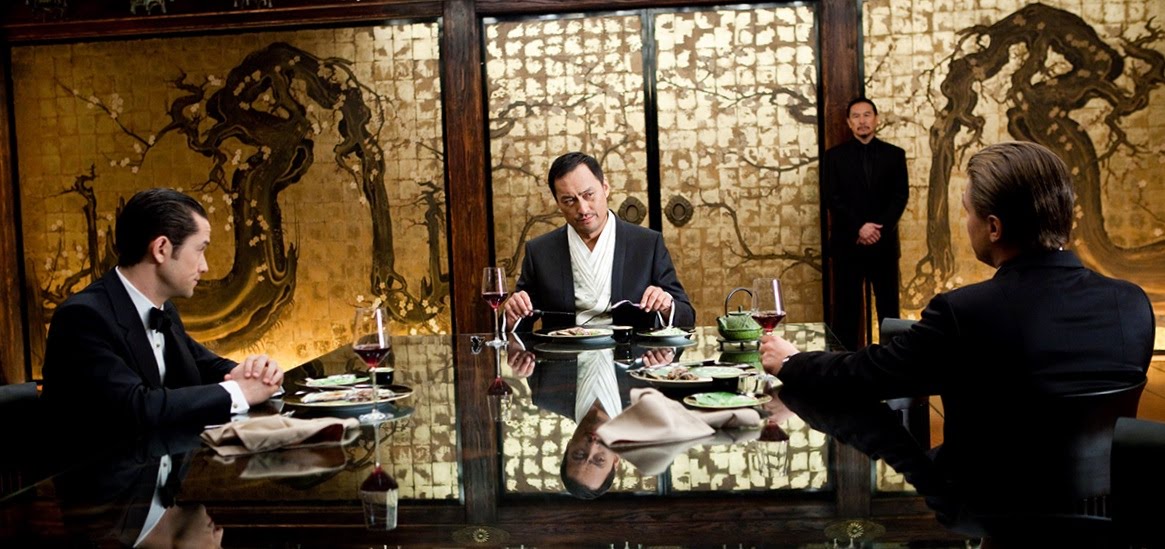

Wow! Inception is a stylised collision of Bourne meeting the The Matrix.

Cobb is on top of his game - the best there is. In becoming the best he has journeyed to places no-one wants to see and feelings of guilt, remorse and his need of redemption are the emotions that drive this story. Written and directed by Christopher Nolan this was never going to be a straight forward walk-in-the-park kind of film. The ensemble cast perform very well together - DiCaprio inhabits a rich vein of performing talent at the moment and his character (Cobb) drives the narrative. Ellen Page (Ariadne) and Tom Hardy (Eames) are also particularly impressive. The story conceptualisation is worthy of award nomination as is the consistent application of CGI which unifies the five dimensions or worlds the story simultaneously unravels through.

Cobb is a thief. His area of expertise is applying a form of military intelligence gathering come interrogation technology to the world of corporate espionage. The technology links people connected to a machine who are able to share a dream together. The dreamer is the architect of the dream which is populated by manifestations of the dreamers sub-concious over which of course they have no control. Encounters within this dream world are used to delve deep into co-dreamers minds to extract secrets, plant lies and whatever else the pay-master desires - inception. The trick is to render the 'target' unconscious in the real world - sometimes enhanced by sedatives for a deeper dreaming experience - and then hook them up  to the machine. 

In a dream an hour in real-world time lasts 10 hours in the dream enabling much to accomplished. Unless the target is trained or has anti-dream counter-measures in place, on waking they feel as though it was just a dream - but by then the damage has been done. Each dreamer fashions a totem that they always carry with them and can use to determine whether or not they are awake or dreaming.

Cobb once went too far with his wife (Mal) who through Cobb's accidental auto-suggestion lost the ability to distinguish between dream states and the real world locking her totem in a safe. She is stuck in Limbo - the deepest dream state with no clear prospect of escape. Cobb struggles to limit the intrusion of Mal from his sub-conscious into any dream that he is in but she always breaks through and wrecks his plans. Accused of her murder back home, Cobb is a global fugitive with many trying to track him down.

Cobb receives an invitation for one last final job of corporate espionage - the pay-off for him would be a wiping of the slate with the US authorities and the chance for him to return home to his two children - a lure too attractive to resist. I'm not going to describe how the story plays out but I will include a PLOT SPOILER about the end so only read on from here if you're happy with that.

Cobb travels the world to assemble a team for this ultimate job. Together they plot and determine that they need a dream that goes to a third level of dreaming - so deep it's just before the limbo state, a dream within a dream, within a dream. All of their planning can never anticipate the interventions that Mal brings to any dream that Cobb is in because she is such a strong part of Cobb's sub-conscious. Following the story is difficult enough without wild cards being played all the time! Suffice it to say that in the end Cobb needs to enter limbo to bring about the successful conclusion of the mission the team is on and to exorcise his own personal demons relating to Mal.

 PLOT SPOILER 

The film ends with Cobb returning to the USA and the family home. As he arrives in the kitchen he spins a brass top - Mel's totem . If it eventually stops spinning Cobb is in the real world, it doesn't, it's a dream. The children see him and run to him for an emotional reunion. As that the hugs and kisses continue, the camera pulls back to the spinning top. It hiccups and the screen goes black and the credits roll. Was it about to topple or was it simply a hiccup and it continues for ever? You decide - but I think the answer will come in the sequel that is now nicely set up.

Any story that forces us into the sub-conscious is an invitation to delve deeper than we would perhaps choose to do. What lurks in your sub-conscious? What regrets and fears do we carry with us every day? How do they manifest themselves when they invade the conscious world of our experience? How do you cope with that? If you could enter your sub-conscious and expunge your demons, would you? What price would you be willing to pay? What would be the consequences and would you be any less the person you were before or would be more integrated and so more of the true person you feel yourself to be? Films like this are invitations to screw with your inner workings. If you really want to do that, go and see a therapist.

A great film - well conceptualised, scripted, acted and shot. Go and see it - but take your totem with you!

I'll give it 9/10!

Wednesday, 28 July 2010

Miller's Crossing


I need to declare up front that I am a fan of the Coen brothers and the way they make films. This did not disappoint. It is a barn-stormer of a film in almost any way you wish to look at it. It may be 20 years old, but because it is set in a composite mythical world constructed from everyone's view of what 1930's gangster run prohibition USA was like, it connects in a way that refuses to let it age. The gentle browns of the colour palette and lighting espouse an almost sepia-toned reverence for a nostalgic golden age when men were men and women were there to do their bidding - and nothing more.

It is not a good film for a positive portrayal of gender roles. This is a very masculine film. There is only one female character and all other women are depicted as either floozies or servile receptionists. Verna is depicted as being as strong as any of the male characters and she is certainly as sharp as anyone in keeping up with the 'who is on which side' evolution of the story.

The iconic moment of the opening sequence pictures Tom's hat blowing to the ground where it rests momentarily before being blowing along a path in the woods at Miller's Crossing - a place at which pivotal events take place. It is reminiscent of the bag spiralling in the wind in American Beauty. It is also an image that haunts Tom - the central character. This is played on to good effect to heighten tension and suspense later on in the film.

The story is set in a an anonymous town enjoying the prosperity and technological advances of the age - trams, street lighting, telephones. The town is run by Leo - a Jewish gangster - who has the Mayor and Chief of Police in his pocket. Nothing happens in the town that doesn't make Leo money and it seems that everything in the town is centred on betting, drinking and maintaining Leo's position as top dog. All is well with the fraternity of Jewish, Italian and Irish mobsters in the town. That is until one of them feels he is being 'unfairly' cheated on.

That introduces the narrative's central theme of honour. As the Italian character Johnny Caspar repeats his mantra throughout the film, 'it's about ethics', we are taken on a grand tour that explores loyalty coming into conflict with the need to control, exert power, display trust and be entranced by love. Caspar has a beef with one of Leo's underlings that he feels isn't playing by the rules. That sets him on collision course with Leo and Tom advises Leo on how best to resolve the impasse to allow business to continue as usual. Leo chooses not to follow Tom's advice and sets up a series of confrontations that spark a mob war. As this unfolds, there are further plot twists revolving around Tom who has ongoing 'business' with Lazarre and Bernbaum - Verna's brother. Further fuel is added to this incendiary mix by the fact that both Leo and Tom are in a relationship with Verna and Leo wants to marry her.

Tom takes things into his own hands in an attempt to resolve things and restore a kind of peace - but it seems that he doesn't have a detailed plan as events repeatedly cause him to improvise and play one mobster off against the other on the fly. This means that Tom is out on his own and everyone feels they have a legitimate grievance against him. Does he set himself up as a crusading saviour seeking to restore equilibrium to a community in conflict and turmoil?

A striking feature of the film is the in-your-face technicolour comic book violence that owes more to the Batman TV series of the 60's and the A-Team of the 70's than reality - a hall mark of the Coen brothers. However, Tom chooses not to engage in physical violence and takes several beatings that if inflicted in the real world would have ruptured many internal organs. (He does once use a chair to defend himself.)

Non-violence in a violent world. Tom chooses to be violent in thought, intent and through provoking others to enact violence on one another. It is as though his inner world of scheming and plotting presents a reality which detaches him from the exterior - a world within a world. Perhaps this is a mirror of the film's central plot - that in a world of illicit gambling and drinking another world exists where the rules are clear, a morality understood and followed and where loyalty is the highest prize. A portrayal of purity in the midst of impurity. What this serves to underline are the dangers of a morality that is relativistic and which fails to acknowledge an exterior source of grace and wisdom. It is totally self-serving and ultimately becomes self-defeating.

The film is dense. By that I mean that it moves at an even pace and absolutely nothing is wasted - it demands complete attention. The acting is superb, the lighting and sets powerfully evocative of something that probably never existed - a simulacrum. The dialogue is pure Coen brothers - no wasted words and much meaning communicated in and through the spaces created by the Director and characters - especially Tom. Additional interest is added through the gay relationship between Dane and Mink which is presented in an open and matter-of-fact way.

I found this film gripping, excellent, convincing, repulsive and at the same time attractive with all the strength of an inescapable addiction. It communicated. Tom is a strong character but we know nothing of him except what we see him do - the same goes for all the characters, there is no back-story, no context. There is one scene where Tom chooses to exercise mercy and compassion. Are these things that inform his normal thought processes? For me it made Tom an even more believable and likeable character. It presented a glimpse of something that could transcend the moral ambiguity and bankruptcy of the narrative - it gave hope.

As a man I could understand and inhabit the world the film presented. It was like a favourite and warmly familiar overcoat that kept you warm. If this is the world as women encounter it, we are in deep doo doo and I am sorry for my complicity in it. Was Verna the only character with a consistent and life-giving morality? I wish to reassure you that I have no intentions of opening an illegal gambling and drinking den or of obtaining a Tommy gun and bumping off people who disagree with me, or playing by a relativist morality that is controlling and exploitative. There is much in this film to repulse the viewer - but this viewer would happily watch it again today - and possibly tomorrow too!

Well worth the investment of time - it will engage you. I'll give it 8.5/10.

Monday, 26 July 2010

Film Club


I have just finished reading the book Film Club by David Gilmour. A couple of years ago a colleague gave me a cutting from a Sunday Newspaper which was the story of a teenage boy who didn't do school. His Father made a bargain with him - he could live at home, rent free as long as long as he didn't do drugs and he agreed to watch 3 movies a week with his Father. This book charts those five years - it is autobiographical for David and his son Jesse.

The book operates in two spheres. Set in Toronto, the author works in TV and has a passion for film having once been Film Critic for CBS. He decides to use his knowledge of film, calling on reviews, books, interviews (sometimes his own) to enrol his son in a kind of Université de Cinéma and give him the education he wasn't getting in school.


The choices of films and his introductory sketches and retrospective analyses are all very apt. The story covers a huge range of genres citing 121 different titles. The insights the films give into Jesse's roller coaster of a life are at times helpful and at other times I felt lacking in sensitivity and positively unhelpful. I'm sure I would have done a worse job! Gilmour covers a breath-taking breadth by putting the spotlight on Directors, then on Actors, the way a film is shot, lighting. He highlights individual lines of dialogue and scenes that he feels resonate with Jesse's predicament. From James Dean's defiant swish of the rope in Giant to Patricia Arquette's motivational 'You're so cool' in True Romance, Gilmour tries to impute the self-confidence, la joie de vivre and lack of ambition his son's unfocused life lacks. I think he tries too hard.


The second sphere is the advice Gilmour gives his son about how to cope with broken romance - a pain that is an integral part of the human condition. The wrong assumption Gilmour makes is that together with the films, his previous romantic and sexual encounters provide all the data necessary to enable him to dispense the words he feels his son needs to hear. Naivete. Stuck in a seemingly endless loop of mismatch of communication ability, Gilmour's verbosity is inversely mirrored by Jesse's inability to articulate or express himself in any meaningful way. Eventually, Jesse does find an avenue to give expression to his hurts and feelings - and maybe even his fears. This confirms to the Father that the son has the greater talent. Jesse discovers the ability to be creative in way that communicates. I strongly feel that this one of the most basic human drives - stemming from the Trinity.


This is an interesting and well written book that tells an important story. My own passion for films and narrative as means of reflecting on daily life is, I hope, well documented on this blog. The book's ability to compel people to develop their own catalogue of films to educate people through is perhaps its lasting and most endearing legacy. What films would you choose - which have instructed you? How would use them? What would your hoped for outcome be? the question go on in the Université de Cinéma.


This is a good read - get yourself a copy.

Reel Issues

I have just completed work for The Bible Society on a study of Invictus. It will be published soon on the their Reel Issues site in the 'Epic' series - check it out.

Friday, 16 July 2010

Water


What's this all about then? Not as the title suggests 'water' - but that is an ever present theme uniting the different strands of the narrative. On one level it could be viewed as a docu-drama. Set in India in 1938 it could be seen as a record of how Hindu society treats widows - even when they are only 8 years old and their marriage hasn't been consummated. It could be seen as an Indian Romeo and Juliet - complete with balcony scene. It's also an interesting piece of social history as Gandhi's mantra is gaining popularity in the last days of the Raj. The film has very few sets, but those it uses it exploits to the full - particularly the waterfront shots in Varanasi. The film is beautifully lit and the camera work is stunning but at times it's very hard to decipher what is being said.

Chuyia is widowed at the age of 8 and in following custom she has her head shaven and is dressed in white. Her family arrange to take her to an Ashram on the banks of the Ganges where she will live out the rest of her life - widows will be cursed if they remarry. Her arrival has a big impact on the community and her feisty behaviour soon sets her against the leading widow Madhumati. To supplement the Ashram's income Madhumati lets the younger more beautiful widows out to sleep with local Brahmans whose attentions are considered a blessing. One of these widows is Kalyani.

Water is always present and the source is nearly always the Ganges (the well in the Ashram presumably shares the same water table). Whether it be for drinking, cooking, ritual cleansing, clothes washing or taking the dead away, bodily or in ashen form, water is the link.

 As the story follows life in the Ashram with all its ups and downs, which include Madhumati's drug taking and the death of an old widow, so we see a chance encounter between Kalyani and newly qualified idealistic lawyer Narayan, who has bought into Gandhi's philosophy. There is an immediate spark between Kalyani and Narayan and situations are engineered to ensure further encounters between the two sometimes using Chuyia as a go-between.

The story paints a stark contrast throughout by setting the traditions of the Ashram and Hindu society over and against the liberalising call of Gandhi and his followers who want to see India develop and move forward. This tension is personified in the developing love between Kalyani and Narayan. Eventually a decision is made and the film heads towards a climax - but there is a twist.

As I indicated earlier, you can watch this film on a number levels. It is a love story. It is social commentary and also an exploration of tradition being overturned by a liberalising trend. What stood out for me?

It is always very difficult to engage with a narrative that is set within and follows the values of a different culture. I have had the privilege of travelling to India many times and I love the country and her people. Time after time I would return home to asked 'what was it like?'. That is the hardest question to answer because the response begs for comparisons to be made. Making comparisons is all well and good when there is what anthropologists call a 'dynamic equivalent' - that is something that acts as a vehicle to allow understanding in one culture to be transferred, with meaning intact, to another culture. India is such a different kind of place that there are few dynamic equivalents - you simply cannot always describe things in India that make any kind of sense in the West. The cultures are too alien.

Therefore it would be all too easy to get hung up on the Hindu tradition of widows being segregated in Ashrams which in liberal Western eyes would be seen as a denial of the widow's human rights. In India religious tradition is deemed to be of higher value than an individual's rights in this case. From our Western perspective the whole notion of arranged child-bride marriages is hard to understand and few would condone it. Yet it is not so long ago in Europe that Children married and were given in marriage.

I would say for me one of the redeeming features of the story was the evident sense of community and interdependence the Ashram demonstrated. These are very Christian values (perhaps human too,) and life in the Ashram would in many ways mirror life in a Monastery or Convent - but we don't admit 8 year olds to religious communities! The denial of potential is for me the saddest thing about this film.

As with all institutions - and especially with religious ones - the story also highlights ever present hypocrisy. As the film opens we are shown words from the Hindu scriptures which teach that a widow who lies with a man will be re-born in the womb of a Jackal. Yet, Madhumati pimps out the girls to enjoy a blessing with local Brahmans. I guess the blessing out-weighs the 'sin'- a theology of convenience.

I was also struck by the treatment of the pain of a challenge to long-established traditions. Each successive generation seems to be more liberal than their predecessors and wants to push back the boundaries and redefine things held dear for centuries. The process of change of tradition can be a slow and painful process. How different societies manage this process and the success of the outcome varies with what is trying to be changed and the culture in which it is valued. If I look back over 30 years of my adult life, it seems that tradition is always under threat of erosion - but I'm sure that new ones are also being established - it's just that we haven't got the benefit of time to give us a long perspective yet.

Finally, I was also struck by the classic love story that lies at the centre of this film. It appeared very Western - as I said, almost Romeo and Juliet like. Perhaps love is the universal experience that has a dynamic equivalent in every culture and the whole film was simply very Indian.

Well worth a watch - 8/10.

Sunday, 11 July 2010

Reading books, sadly not watching movies!

I have been away for a while recently and being on the road affords little opportunity to catch a movie. I have however been reading and would commend these titles:

Kieslowski on Kieslowski


As you know I have been working my way through his creative output. This book is very helpful as it gives a lot of biographical data and explains why Kieslowski chooses to place the emphasis where he does when he is telling a story. It's an easy read and well worth the investment of time. I want to revisit all his films now - but especially Red from Three Colours as he explains what the story is about and I didn't pick it up first time.

I know I'm the new kid on the block, but I've just discovered the BFI Modern Classics series. I have read the one on Three Colours and it is both extremely well written and very helpful in exploring plot development and the context of the stories.


I also read in the same series:


which remains my favourite film (or trilogy) of all-time. I found this book to be so full of attempts to engage in academic points scoring that I barely got to the end. This book is definitely a case of style triumphing over substance. I did however read this:


which was first-class, so much better than the BFI offering. It is a very engaging and critical exploration of the main themes of the first film in the trilogy. I highly recommend it.

I have bought, but not yet read the BFI Modern Classic on Blade Runner  which I hope will restore my faith in the series of books - I'll let you know how I get on.

Friday, 11 June 2010

Don't give up hope!

A very busy week and now off on holiday! No films  :(

Don't give up hope. While I'm away I'll be working on a Reel Issues Epic Study of Invictus.

Tuesday, 1 June 2010

A Challenge!

I've been challenged to say a little more of what I actually think about the films I watch. A reasonable thing to ask. Let me comment further on the two most recent viewings.

It seems that every German city has a Turkish population. I stay with friends in Wiesbaden fairly regularly and they live near the Turkish district - you walk through it on the way into town. This made the film very real for me as I could imagine the scenes from Bremen happening in Wiesbaden. I have been to Istanbul and also to Azerbaijan and the city scenes and country landscapes reminded me of places I had visited in a generic sense. I could feel the heat of Istanbul and the wind on the ferries as they crossed from Asia to Europe. As I said it felt very real and in that sense familiar.

What was unfamiliar to me was the complex web of relationships that drew the six central characters together. I am grateful for that. Loneliness, passion, the need to make a difference, the desire for a quiet life, an openness to help. All of these are emotions and desires that are commonplace and everyday.

Every story is a journey. It seems a little extreme and tragic that so much pain has to be suffered before Nejat was able to seek reconciliation with Ali. Was Lotte kind or simply naive? Was her death something waiting to happen or a terrible coincidence? Did the forgiveness of Suzanne towards Ayten really motivate her to repent and leave prison a de-radicalised person? Would Yeter have been better off staying in the brothel? This film leaves me with many unresolved and possibly unresolvable questions. I am happy with that as I watch films to be stimulated, to have lots of little thoughts set running. Some of these lead nowhere, others get stuck for a bit and then out of the blue weeks down the road off they go again. That is the power of story. A power to enthral, to make you one with the story, to transport you, to raise questions, to show you things you've never even thought of before. When we watch with others, we travel together. Although our destinations may be different we have companions and that is precious.

I greatly appreciated the way in which this story was told. It was clever and non-linear. You had to concentrate and work hard to make the connections. I wonder how many I missed? I guess at the end I felt numb and disappointed. So much pain and hurt for what? But sometimes isn't life like that?

Doubt similarly left me with the same kind of feelings. The central question is 'did he or didn't he?' How you answer that determines how you feel about Father Flynn and in a sense Sister Aloysius. Given the current coverage of priests abusing children, this film has an immediacy that lifts it from the 1960s and plants it firmly in the here and now. This is not simply a story about liberalisation of education, the church and desegregation. It's a story about trust. Of all the people within a community, it is the religious leaders that we should be able to turn to without first having to run their morality over some kind of metric.

In the film, did father Flynn do anything inappropriate with Donald Miller? I was totally prepared to believe Father Flynn's story until he resigned on account of Sister Aloysius' bluff about checking with his previous church and school. Why resign if you are in the clear? Was it simply that he wanted to spare Donald from the publicity that would result? Were the hierarchy complicit in turning a blind eye to abuse? That seed of doubt has been planted and my fertile mind all too readily propagates it and nurtures it to become something much larger, more menacing and destructive than it was to begin with. Is this right?

What are we to make of the battle-axe who is Sister Aloysius? Do two wrongs make a right? Were her good intentions for the welfare of the boy sufficient on their own for her to pursue a witch hunt? What about her disregard for authority and following protocol? What about the state of fear she induced in the community - is that what community is really all about?

As a model for priestly ministry, Father Flynn has much to commend him - and I write as one charged with the formational oversight of priests as they train! His manner was very pastoral. He was unafraid to challenge when it was necessary. His highly contextual and narrative style of preaching had much to commend it. A perfect role model?

The film succeeds in raising doubts about a whole heap of things. I guess it achieved what it set out to do.

I hope that helps. Leave a comment to let me know.

Sunday, 30 May 2010

Doubt


This film's title is not only descriptive of what it's central theme is, it is also what you're left with after watching it. Subtitled 'There are no simple truths', this film attracted five Oscar nominations with heavy-weight performances from Meryl Streep, Philip Seymour Hoffman, Amy Adams and Viola Davis.

Father Flynn preachers a sermon on doubt - which of course everyone feels is directed uniquely at them. This irritates Sister Aloysius, the school Principal and a member of the Sisters of Charity. Set in the Bronx 1964, the film is dimly lit and monochromatic which reflects the world as the puritanical Sister Aloysius sees it. The wind of change from Vatican II and the aftermath of the death of Kennedy are blowing through the Catholic Church and the USA. The priest is trying to usher in a more progressive and humanist (liberal) approach. Sister Aloysius still relies on the old way (conservative) of doing school - by instilling the fear of Sister Aloysius into pupils - and staff!

Suspicions are raised about Father Flynn's behaviour with the only black student in the school. Sister Aloysius dislikes Father Flynn immensely - not only for his preaching but also for the fact that he uses a ball-point pen, takes three sugars in his tea and likes Frosty the Snowman! Having built a hatred based on irrationality, it is impossible to determine if Sister Aloysius' feelings are a true reading of character or simply more prejudice.

In the power struggle that ensues, there are no winners - only losers. I'm keeping this short so that I don't give too much away. This is an intellectually stimulating film that deals with real issues that very topical, with fine acting and an uncertain outcome. Excellent cinema.

I wish I could preach like Father Flynn.

I'll give this 7/10.

The Edge of heaven


Well! Where to start with this one?

The English name of the film has no correlation to the German name 'On the Other Side'. Perhaps it's random. The story appears to be, but it is actually extremely cleverly put together and told in a compelling way that draws you in. This is a German/Turkish film set in those two countries. The principle locations being Bremen and Istanbul.

The opening scene is of a car pulling into a dusty petrol station in a remote corner of Turkey. The driver gets his tank filled and buys lunch for the road. The music playing in the station is by a local celebrity who died a couple of years earlier from cancer which the owner blames on Chernobyl. The owner says to the driver 'he was young - like you. The driver pauses momentarily to reflect.

Ali is a retired Turkish immigrant living in Bremen who has long been a widower. He seeks comfort in the services of a prostitute, Yeter. He makes return visits to enjoy the services she offers and eventually offers to pay her the same amount of money she currently earns if she will live with him and provide her services when asked - nothing more.

Ali's son is Nejat is a Professor of German Literature and as a second generation Turk in Germany is able to move fluently between the two cultures. Before he is able to get his head around Yeter's arrival in the family home Ali suffers a heart attack. On release from hospital, Ali suspects Nejat and Yeter of being lovers and as he argues with Yeter in his drunkenness he pushes her and she falls hitting her head on the bed-frame and dies. Ali ends up in prison.

Nejat is appalled by his fathers actions and goes to Turkey to look for Yeter's 27 year-old daughter Ayten with whom she had lost contact. However Ayten who is a political activist in Turkey flees the country when the radical cell she is a part of is raided by the police. She flees to Germany on an illegal passport and is already in Hamburg looking for her mother when she dies. At one point Ayten is riding in a car next to tram in which her mother is riding - they don't see each other. As Nejat arrives at Istanbul airport we see Yeter's coffin being offloaded form a plane. Nejat enlists the aid of his family and puts up posters all around the city with a picture of Yeter on it in the hope of finding her daughter - who is in Germany.

Ayten strikes up a friendship with university student Lottie who invites her home to stay - much to the dislike of her mother Susanne. Ayten and Lottie become lovers. Eventually the law catches up with Ayten and she is deported. On arrival in Turkey she is arrested because of her political activity. Distressed Lottie flies out to Istanbul to try and seek her release. It takes her several months simply to get a permit to visit Ayton. Lottie ends up being shot by some kids high on solvents. We then see Lotties coffin being loaded onto a plane in Istanbul.

As Ali arrives back at Istanbul airport, he is taken away by immigration officials who presumably want to check on why he has been deported. At the next immigration booth is Susanne. The story is filled with these coincidences, parallel stories and near-misses that embrace the six central characters. From a camera high up in the corner of her hotel room, we see Susanne plumbing the depths of grief for her daughter. She eventually calms down and meets with Nejat who has bought a shop selling German books. Susanne wants to see where Lottie was staying - she had rented a room from Nejat who, had no idea that Lottie was looking for the daughter of Yeter too. Susanne ends up staying in the same room. After reading her daughter's diary she decides to take up Ayten's cause and visits her in prison offering forgiveness. This in turn encourages Ayten to exercise her right of repentance and she is released from prison.

Nejat and Susanne see crowds of people flocking to the mosque to observe Bayram - a Muslim observation of Abraham's obedience in his attempted sacrifice of Isaac. The sacrifice of children hold a place of special significance for both Susanne and Nejat. This is a central theme of the narrative.

Nejat asks Susanne to look after his shop as he heads East in search of his father near Trabzon on the Black Sea coast. It is Nejat who stopped at the petrol station at the opening of the film and that segment is now repeated in its correct place. When he arrives in the village, Ali is already out fishing, Nejat sits on the beach awaiting his father's return and the reconciliation that it will bring.

End of film.

My ramblings here have not done the story and the way it is told justice. The acting is very good and the locations have an earthy reality about them. I strongly urge you to see this film, you won't be disappointed. I'm going to give it 8/10.

Sunday, 23 May 2010

Crimes and Misdemeanors


Is this film really 21 years old? I still rate this as the best Woody Allen film I've seen - which isn't many as I'm not really a fan. But that aside - this is good. The film was nominated for three Oscars. I saw this again on Friday evening with a group of curates as part of a training weekend exploring the question 'what is the worth of a human'. It proved to be a good choice which set up the weekend well and provide rich material for reflection around our theme.

Set in New York the film is, as all Allen's films usually are, auto-biographical. Allen stars as Cliff, a small-time movie maker who's short on work and high on ideals. He has been shooting a documentary about the views of a Jewish Philosophy Professor, Dr Levy. Levy's outlook on life seems to be a blend of common-sense pragmatism with an acknowledgement that humanity needs a moral code and something in which to believe. Essentially he preaches a secular message of hope. Cliff is locked into a life-less marriage and his self-absorption is clearfly driving a wedge between him and his wife.

Judah is the other central character. A successful ophthalmologist who is a respected pillar of New York's Jewish elite and a generous benefactor to a range of projects. He lives with Miriam, his wife of 25 years, who enjoys the trappings of comfort and success and their luxury home well outside the city.

Cliff's brother-in-law is Lester who is a highly successful and critically acclaimed producer who is full of himself and repeatedly dictates reminders about possible projects into a pocket dictaphone - much to everyone's, and especially Cliff's, annoyance. Cliff hates Lester's success and so hates Lester and a series of penetrating one-liners are thrown his way such as "Lester - he's an American phenomenon" to which Cliff responds "so is acid rain!". Ouch.

Ben is a Rabbi who is losing his sight and a patient of Judah. The loss of Ben's physical sight and the clarity of his spiritual and moral sight provide a powerful metaphor that underpins the story. So much of the plot is about what might be seen, what has been seem and what is plain to see.

Judah has been having an affair with Dolores, an airline attendant after a chance encounter on a flight to Boston. For two years he has been living a double life spending weekends away with Dolores when ostensibly he was attending a conference. Dolores has become neurotic and her need-to-be-needed has taken control. She threatens to tell Miriam of the affair unless Judah leaves Miriam to be with her. Judah cannot allow his world to be torn down by Dolores who refuses to listen to reason and becomes increasingly unstable and erratic. Dolores also threatens to blow the whistle on Judah's financial impropriety which would further ruin his standing in society. In desperation Judah turns to his brother Jack who is clearly a man with under-world connections. Jack's advice is that Miriam is taken out - he sees no other solution that would satisfy Judah's demands.

Meanwhile. Judah confides in Ben during a consultation and Ben suggests a range of things that spring from his hopeful optimistic view of life. Ben says "sometimes when there is true love, there can be forgiveness" and "Give the people you've hurt the chance to forgive you." After the encounter Judah is thrown into deep moral dilemma and remarks that "God is a luxury I can't afford" and "I will not be destroyed by this neurotic woman!".

Meanwhile, out of pity for cliff and as a favour to his sister, Lester invites Cliff to make a documentary about him and his take on comedy. Cliff reluctantly accepts and says he will use the money to complete the documentary he is making on Dr Levy. One of Lester's entourage is a producer Halley who Cliff immediately falls for. He takes her to the cinema and also shows her some of the Dr Levy footage which she says would make a great episode in the show she is producing. The relationship grows - but unfortunately for the hapless Cliff, not romantically.

Desperate, Judah calls Jack and tells him to go ahead. Later that evening when Jack calls to report that the deed has been done and it will look like a simple burglary, Judah's moral compass begins rotating and spinning wildly. He experiences flash backs to his childhood where the family sitting around the table sharing a seder meal. Judah's father, a man of deep faith and regular synagogue worshipper, says that he will always choose God over truth and that God's eyes see everything. He tells jack 'may God have mercy on us" and reiterates that the eyes of God see everything.

Judah then visits the scene of the crime to remove incriminating articles. Seeing Dolores dead, her big dark eyes now life-less and empty plunges him into inner turmoil and waves of guilt relentlessly sweep over him. The next day he turns up at the childhood home and the owner invites him inside. In his mind he is taken back to the Seder in which he is present as both his present and his younger self. This encounter only adds to his guilt. he takes to the bottle and becomes withdrawn and depressed.

Lots of other things are ongoing within the web of relationships that the film weaves. Cliff enjoys a very close and familiar relationship with his niece Jenny. Given the timing of the film, it is worth asking the question if tyhis portrayal is a mirror of what was going on with his real-life adopted daughter  Soon-Yi Previn whom he later married!

The outcomes leave Cliff living a downward spiral of self-fulfilling doom and gloom whilst Lester's stock continues to rise. In the end he captures Halley just to drive home Cliff's feelings of inadequacy. Ben loses his sight but appears to be reconciled to it and there is a lovely intimate dance with his daughter on her wedding day. Judah decides he can live with the knowledge of the murder he commissioned safe in knowing that his reputation and marriage are once again safe.

The film has so much in it about the worth of a human. Go watch and see what you see in it.

I'll give it 7.5/10.

Wednesday, 12 May 2010

Black Hawk Down


I was visiting a Theological College on Monday and walked into the Common Room to find a group of guys settling down to watch this. I joined them.

I thought that The Hurt Locker was enough blood-spattered modern warfare for the time being. In watching Black hawk Down I was in for a drenching in blood and assorted body parts! The story is set in Somalia in 1993 when the Americans enacted a mission to capture two lieutenants of the Somali war lord Mohamed Farah Aidid. The raid was successful but in withdrawing a Black Hawk helicopter was shot down and when another went in to rescue the occupants, it too was shot down by RPG. A task force of 100 US Rangers and special forces troops were despatched to recover all personnel and destroy what remained of the helicopters.

They encountered much stiffer opposition than they anticipated and the operation turned into a 15 hour fire-fight with much close quarter combat. The General commanding the operation was forced into committing an ever increasing number of resources to mount a recovery operation. Ridley Scott captures the visual reality of modern warfare where high-powered bullets shatter limbs and RPGs cut bodies in half or pierce torsos without detonating. It is bloody, gruesome and in-your-face. Not for the faint-hearted.

It ends with the Americans withdrawing all their men except a captured pilot - Durant. The movie ends with "1000 Somalis died and 19 Americans lost their lives in the conflict (the 19 soldiers and officers who died are then listed by name and rank). Mike Durant was released after 11 days of captivity. On August 2, 1996, warlord Mohamed Farrah Aidid was killed in Mogadishu. General Garrison retired the following day."

What the film fails to do is portray the real reasons the Americans were there (a unilateral UN?) and to show the Somali's as little more than mindless violent and bloodthirsty thugs. Why do Americans elicit that response where ever they intervene abroad? Some of those involved in the production were critical of the final version as it played down any understanding of the complex relationships between the Somali militia and played up the heroic exploits of the US military. As cited in Wikipedia: In a radio interview, Brendan Sexton, an actor in the movie, said that the version of the film which made it onto theater screens was significantly different from the one recounted in the original script. According to him, many scenes asking hard questions of the U.S. troops with regard to the violent realities of war, the true purpose of their mission in Somalia, etc., were cut out. Sexton wrote an article in 2002 where he maintained that Black Hawk Down failed to explain the reasons behind the Somali population's opposition to the U.S. military presence in their country: 'The Somalis are portrayed as if they don't know what's going on, as if they're trying to kill the Americans because they — like all other "evildoers" — will do anything to bite the hand that feeds them. But the Somalis aren't a stupid people. In fact, many were upset because the U.S. military presence propped up people tied to the old, corrupt Barre regime.'

Gripping, dirty, as realistic as I want to see and probably way short of the actual horror of war. I'll give it 7/10 as a movie and 3/10 for a selective retelling of history from the perspective of the winner.

Spirited Away


This formed a members free screening double-bill (with Ponyo) at Harbour Lights on Sunday - great value. If you live anywhere near Southampton do check it out and join!

I had seen this a couple of times before, but watching on the big screen presented the narrative and images in a very different way - more engaging, and again I was drawn in. Spirited Away is Japan's biggest grossing film at the cinema of all time. This is important as it underlines the resonance of the themes dealt with in the film. I am largely ignorant of Japanese culture and the prevailing Shinto religion, but it was clear to me that the motifs portrayed in the film represent a blending of present and past, of spirit and reality, of traditional values and contemporary revisions to them. I urge caution in being too interpretive when I know so little of the culture the narrative speaks from and to. At just over 2 hours long, it is perhaps a little too long - but obviously not for a Japanese audience. This is clearly a 'coming-of-age' story as Chihiro battles with the uncertainty of moving from the familiar to the unknown.

Chihiro is a spoilt 10 year-old girl travelling by car with her parents to their new home. Her father takes a wrong turn and tries a short-cut through a forest. They end up at what looks like an abandoned Theme Park. On exploring the park - which gives Chihiro the creeps - they discover a stall of freshly cooked food. The parents tuck in enthusiastically while Chihiro refuses to eat and goes off to explore. She meets a boy named Haku who seems disturbingly familiar. He advises her to leave with her parents immediately - before darkness comes and the spirits who inhabit this world come to life. Chihiro returns to her parents who have eaten the entire stall's-worth of food and have transmogrified into pigs! Chihiro tries to escape but the way back to the car has been transformed into a huge river that now blocks her path. Haku offers to help her.

Haku leads her to the bathhouse for the gods and tells her to go to the boiler room and ask for work from the six-armed boiler man Kamaji. Her persistence pays off and she is helped by Lin an older girl working in the bathhouse who helps her meet Yubaba who runs the bathhouse. Yubaba eventually gives her a job but takes her name and renames her Sen to ensure eternal slavery.

Haku, who was originally a spirit dragon is similarly enslaved by Yubaba. He is sent on a mission to steal a magic seal from Yubaba's twin sister Zeniba. The seal causes Haku to become ill and as Sen forces him to cough it up, Haku also coughs up a little black slug thing which she squishes under-foot. It turns out that this was the embodiment of a spell Yubaba had put on Haku to ensure she retained control of him.

Sen, accompanied by No-Face, a spirit she has befriended form the bathhouse, Boh, Yubaba's gigantic baby son now turned into a rat and Yubab's pet raven, now a fly, journey's to Zeniba in a bid to gain freedom and end the dominance of Yubaba. Zeniba is a lot friendlier than might have been anticipated and tells Sen that her love for Haku has broken the spell that kept Haku captive. Zeniba and Sen's friends make Sen a special hair band to show her that her friends are with her, as well as for protection. Haku arrives to take Sen back to the bathhouse. No-Face is offered the chance of staying with Zeniba which he accepts. Haku explains that Yubaba will set Sen and her parents free in exchange for Boh.

As Sen, the rat and the fly ride on Haku the dragon, Sen realizes that Haku is the same river spirit that saved her as a small child when she fell into the Kohaku River, and the realization helps to break Yubaba's control on Haku completely. Sen is set a further test by Yubaba to get her parents back which she passes. Haku accompanies her back to the entrance to the spirit world and tells her that her parents are waiting on the other side. She is told not to look back or else the deal is off. Sen, now restored as Chihiro rejoins her parents who walk back to the car covered in dust and foliage to indicate the passing of time. Chihiro still has her hair band in place which indicates that it wasn't a dream as her Alice-in-Wonderland type experience remains real in the real world.

I won't pretend I know enough to try an unpick what the film alludes to in Japanese tradition and understanding of the spirit world. There is an interesting piece in Wikipedia that's worth a look.

Ponyo


Watching Ponyo took me back to my childhood and TV series such as Marine Boy and Astroboy. The animation and conceptualisation draw directly from the genre these represent. It says something when a 101 minute film which essentially tells a children's story captivated and drew in this adult!

Ponyo is a goldfish. She lives in an an undersea aquarium, the daughter of a former human turned undersea sorcerer Fujimoto and Granmamare a sea goddess identified in the story as the goddess of mercy. Ponyo yearns to explore and break free from the constraints of home and ends up in a rock pool where she is discovered by Sosuke - a five year-old boy. As he rescues her, he cuts his finger and Ponyo licks the wound, tastes human blood and Sosuke is healed. Sosuke declares that he will love and protect Ponyo forever - whatever it takes.  Fujimoto sends his sea spirits to recover Ponyo whom he thinks has been taken prisoner by humans. Having tasted human blood, Ponyo now possess the capability to transform herself into a human.

Once back in Fujimoto's clutches, Ponyo uses his sorcery to escape and also to transform herself into a human.  Ponyo's dabbling with marine magic upsets the balance of the sea and the natural world, even drawing the moon closer to the earth and so upsetting the tides. In the ensuing storm Ponyo escapes and is reunited with Sosuke. Separated from his mother by the storm, Sosuke and Ponyo go in search of her only to find her and the retirement community with whom she works, under the sea in a protective bubble with Fujimoto. Fujimoto summons Granmamare who comes to him and Ponyo. The only ways for the equilibrium of creation to be restored is either for Ponyo to revert to being a fish or for Sosuke to declare his undying love for her. I'll leave you to guess how it works out!

The animation and story-telling are first class from Studio Ghibli. The American dubbing of the voices boasts an all-star cast. This really is an excellent film well presented, well paced and interesting as well as enjoyable. It is complete fantasy and myth that collides with and impacts our reality. Out on DVD on 7 June - you can pre-order now.

I'll give it 8/10.

Tuesday, 27 April 2010

The Hurt Locker


This is an engaging, depressing but gripping movie. It is almost a docudrama with its use of hand-held cameras throughout, its tight-cropped head shots and reeling shots as a reaction to explosions. It is tight, well-paced, well acted and portrays a realism that is too real for the senses to comprehend. It is an excellent film.

The story is simple. The film follows a group of three American soldiers on deployment in Baghdad. Two are regular infantrymen, the third is an explosives expert who disarms IEDs. He is excellent at his job but he is a maverick and his lust for taking things one step too far endangers not only his own safety but also the safety of his colleagues time and time again. After one particularly heroic/cavalier disarming, he is visited by a General who congratulates him on his good work and his attitude. The conversation reveals he has defused more than 880 bombs. He is hooked and lives between the chase to defuse and feelings of guilt over not being there for his young son back home.

The story counts down day-by-day as the end of their deployment approaches. Will they survive? A chance encounter in the desert with an SAS unit hunting down war criminals provides a welcome respite from the chaos of Baghdad - but also a gruesome and unwelcome insight into the clinical effectiveness of long range sniping.

Reminiscent in some ways of The Deer Hunter and countless other Vietnam movies where the would-be liberator becomes the entrapped and addicted victim. War is a terrible thing and nations should enter into it only after all other avenues have been exhausted. It seems that with WWII, Korea, Vietnam and now the Gulf and Afghanistan that successive generations of Americans are forced to live with the unseen but very real consequences of warfare. As fighting wars becomes increasingly 'virtualised', where will that take our children's generation? I guess Halo, Gears of War and Modern Warfare 2 have already given us a glimpse!

As hard as this film is to stomach, it is a must-see as we are all culpable for the atrocities each side inflicts on the other in the name of justice and freedom. How you choose to define justice and freedom depends on which side of the battle you are on!

I'll give this 8.5/10.

Thursday, 22 April 2010

Psycho


On to the real thing!

This is the third or fourth time I have seen this film over the past 40 years. It still had me on the edge of my seat and made me jump on more than one occasion. Filmed in black and white, the subtle palette of tones and careful lighting are brilliantly used by Hitchcock to deliver a film that is as fresh, disturbing and scary as the day it was made 50 years ago. With towering performances from Perkins, Leigh and the rest of the cast, this film really is a tour-de-force. The soundtrack and opening credits reinforce the sense of paranoia and schizophrenia.

Desire, opportunism, naivety and circumstance conspire to deliver a story that gallops, then slows and then gallops again. The relentless nature of the changes in pace is exquisitely orchestrated by Hitchcock to lull the audience into false senses of security which are immediately challenged in a helter-skelter frenzy of love, theft, murder and horror. For some reason my parents allowed me to watch this at a relatively young age and image of the chair swinging around has been burned into my mind for four decades! It has never 'troubled me', but as someone who has never been into horror, it's as horrifying as I want to get! Perhaps that's why I don't like horror as a genre?

The sheer attention to detail that Hitchcock demonstrates is a lesson modern-day film-makers would do well to learn. I was however struck by how much of the narrative had to be explained in the screenplay as though the audience were not capable of understanding. I find this kind of woodenness frustrating and it appears in too many films today - just listen to Avatar as an example! I guess the erudite and insightful diagnosis by the psychologist at the end of Psycho was necessary for a generation much less conversant with Freudian psychology than people today.

I am glad I went to see this remastered version in the cinema even though I own the DVD. I'd go and see it again tomorrow and the next day and each time I'd see something new. I forgot to look out for Hitchcock himself - well that gives me a reason to see it again - now where's that DVD?

Worthy of 9.5/10 any time!

The Ghost Writer


Roman Polanski's long-awaited and much heralded film about an obscure ghost writer (Ewan McGregor) who is hired to bring order from the chaos that are the memoirs of former British Prime Minister - Adam Lang (Pierce Brosnan). Based on the Robert Harris novel and acknowledged to be inspired, more or less by Tony Blair, this film is a political thriller that moves at a steady pace. There are some neat twists and turns along the way and the heavy-weight cast give solid but unspectacular performances. Ewan McGregor at last presents a largely believable accent. This film is okay - even possibly good, but at the end of it I was somewhat disappointed.

The publisher has paid $10m for the memoirs and they are in a mess. The previous ghost writer, a close friend and associate of Lang for more than 20 years is washed up dead on a beach with half a bottle of whisky in his blood, his car still on the ferry that connects the island to the mainland. The publisher imposes a 4 week deadline for the 'ghost' to do his work - a tall order. Lang is undertaking a speaking tour of the USA and is holed up in a reclusive luxury heavily guarded island beach side villa with his up-tight wife and admin team. The 'ghost' begins his interviews but there are many interruptions and some areas are out of bounds. But as the emerging story unfolds, there are many loose ends and things begin to not add up. The windswept and desolate isolation of Lang and his party in the villa is a powerful metaphor for Lang's isolation and segregation from the world.

Things hot up when a former colleague feeds information to the International War Crimes Court implicating Lang in using evidence gained under duress by the CIA. Lang is then forced to stay in the USA as they do not recognise the jurisdiction of the court. This part of the plot is highly ironic given Polanski's current house arrest in Switzerland pending extradition to the USA!

A protest camp materialises at the gates to the beach villa and angry crowds confront anyone going in or out. Meanwhile the 'ghost' does some of his own digging around and the locals give him further evidence that his predecessor's death was suspicious. As he drives the guest car, the Satnav is determined to take him somewhere and eventually the 'ghost' twigs that this would have been his predecessors last journey. he follows the route which takes him back to the mainland and the plot thickens. Towards the end it also quickens and there are some unexpected twists.

I won't say too much more about the story in case you want to go and see it - which is worth doing. (IMDB currently scoring it 7.9/10 and Rotten Tomatoes 84%.) Some reviews have hinted at a Hitchcock-like quality to the film. I think this more cock and bull than Hitchcock - particularly given the review of the film I saw back-to-back with this above!

I'll give it 6/10.

Tuesday, 20 April 2010

Run Lola Run


For once I totally agree with the review quotes on the DVD case - this is a breathtaking film. It's only 77 minutes long but you need to stop then for a rest! The film opens with some of the characters in a crowd outside a football stadium asking philosophical questions about humanity and how we know what truth is. Starring Franka Potenta as Lola (Bourne Trilogy [Marie] and House [Lydia]) the then girlfriend of self-taught Director Tom Tykwer, the film moves at relentless pace as it tells the story of Lola's dramatic and breath-taking efforts to save her boyfriend Manni, from mob execution in 20 minutes! All she needs to do is get €100,000 and deliver it to Manni down-town within 20 minutes - simples!

How can a film of 77 minutes duration cover only 20 minutes in real time? That's the clever bit. For some reason Lola doesn't use the €100 in her pocket for a taxi, but decides to run everywhere. She's quite an athlete. After she receives the phone call from a distressed Manni she runs helter-skelter to the bank where her father works - surely he can release €100,000? The clever thing is that the story from that point on is repeated twice so the viewer gets three different outcomes. The sprint to the bank is slightly different each time and the outcomes are markedly different.

I'm not going to spoil the story for you but one piece of advice the film dispenses is to avoid buying a white BMW! Now, if the plot and the way the story is told has got your attention, then the way in which it is presented will hook you and reel you in with consummate ease. The physical pace of Lola's relentless running is matched by a techno soundtrack with the vocals provided by Potenta. This is backed up with stunning visuals that cut and jump at an equally frenetic pace. As Lola runs from the apartment block the camera enters a TV that is playing a cartoon of her running in descending spirals down a seemingly endless staircase. On the street as she passes people we are treated to a fast changing montage of still images depicting their future and life outcome. This changes on each of her three encounters with them.

The story is very much about how small seemingly unimportant events - quite often seen as peripheral to the central thing - can determine major outcomes in unexpected ways. The film is essentially one long "What if?" question. The Director explores a number of possible outcomes to a simple situation - €100,000 in 20 minutes when the life of someone you love is on the line. There is a short scene in the film where Lola and Manni are in bed and they ask each other a series of questions about love, commitment and their relationship. This interlude from the relentless physical running helps to re-engage the story with the philosophical questions posed right at the beginning by mirroring the physical with intellectual and emotional questions which are running in the background.

I can imagine that this is a film that you will either like or dislike strongly - it will not permit fence-sitting. The actors and their characters will essentially appeal to a younger audience and the visual style and relentless soundtrack also push the film in that direction.

I think this is an excellent piece of cinema. A simple story well told - three times. If you haven't seen it - go and find a copy of the DVD. I'll give it 8.5/10.

Sunday, 18 April 2010

Lemon Tree


This is a powerful and moving film with exceptionally strong acting performances. It would be easy to say that this is demonstrative of the Palestinian struggle against the occupying Israeli forces. The picture is so much more complex and as is noted in the film, based on a struggle that has been ongoing for 3000 years. Let's consider this film as illustrative rather than demonstrative.

The plot is quite simple. Salma Zidane is widowed and her children have left home. She tends her inherited lemon grove and ekes out a subsistence living with the aid of Abu Hassam who has worked in the grove for 50 years. One day new neighbours move into the swanky new villa next to the grove - it happens to be the Israeli Defence Minister and his wife. The secret service consider the lemon grove to pose a threat as terrorists could launch an attack from there and so issue a notice to requisition the grove - generously offering compensation.

Zidane decides to fight and, with the aid of a local attorney, the struggle progresses through the courts and ends up in the High Court. Meanwhile, the Minister's wife is concerned about the way in which the land is to become a sterile safety zone ending her neighbour's livelihood and demeaning the respect of the tradition the inherited grove represents. She seeks to make contact with Zidane but is prevented by her minders. The case gains not only local and national notoriety, but also becomes an international news story. The Minister is put under increasing pressure in news conferences where the questions always turn to the lemon grove. The stakes are raised even higher when his wife gives an interview to an old friend who is a journalist and basically supports the Palestinian woman and not her husband.

The outcome is powerful and no-one caught up in the story escapes the consequences of the outcomes, either by justice through the courts or in terms of relationships. I won't spoil the end as it's a fairly recent film and you may wish to watch it - I recommend you do.

I often comment on violence within films on this blog. Usually, I am referring to the blood and guts, fisty-cuffs and weapons type of violence. This film is the most violent I have seen in a long time. The calculated violation of Zidane, her family and her people is mind-numbing. The actions of the Israelis are predicated on a potential threat that may or may not materialise. As is pointed out in the film, no terrorist activity has been linked with grove since the creation of Israel in 1948. the justice meted out by the Israeli Supreme Court is a justice based on a utilitarian ethic and is not justice in the eyes of the Palestinians. Context is everything - even in terms of deciding what is just.

The closing picture of an isolated and lonely Minister and violated and brutalised woman shows that there are no winners in this game.

A brilliant film. Get hold of a copy - I am going to! I'm giving this a rare 9/10!

Angel-A


This is the second time I've seen this film and I liked it even more this time. Watching it with a group of 'filmies' was interesting and scores ranged from 1-9.5! Film watching is highly subjective.

Andre is a small-time crook who borrows more than he can ever repay and is then faced with retribution from the villains he defaults on. At the end of his tether and getting no help from the police, he climbs a bridge parapet and prepares to jump. He then notices a girl preparing to do the same. She jumps into the river below and he follows suit in an attempt to rescue her. He can't swim and she ends up pulling him onto the bank!

Andre is short and dishevelled, The girl is at least 6' tall, slender, dressed in a mini-dress and high heels which show off her amazingly long legs, blonde and stunningly beautiful. It transpires that she is an Angel who has been sent to look after Andre and help him to discover his true inner self and to love that self. We learn that Angela is the embodiment of his inner self - big, beautiful, resourceful and totally loveable.

The story has many amusing twists and turns. Shot in black and white against a stunning Parisian backdrop, it is visually engaging. The thugs and sleazy underworld of Andre's existence are portrayed with garish realism - even in monochrome. This is a true David and Goliath type story as Andre makes a remarkably quick transition to his new self. I won't spoil the outcome for you, only pose the question 'what happened to Catherine and the kids?'

Yes you have to suspend some belief to watch this tale, but it is quirkily enjoyable and raises a familiar filmic story in a different and visually entertaining way. The acting and scenery are very good. Make sure your copy has subtitles - unless you're fluent in French.

I liked it - I'll give it 8/10.

Saturday, 17 April 2010

The Road Home


This is a gentle yet powerful tale from Zhang Yimou. I'm going to say very little about the story as you need to watch it unfold for yourself. The central themes are of love, commitment, patience, hope and a valuing of the old ways. The story is also strongly political and challenges the Communist Party Dogma with good old common sense.

The acting performances from Zhang Ziyi and Sun Honglei are very strong and believable. There are many cultural references that Western viewers will miss, but that won't detract from the benefit of watching this film. It is a story that invites you to place yourself within it and ask how you might respond. The potential for a tear to well up comes at several stages - particularly so as the film reaches its climax. The landscape and setting is mesmerising. the sense of collective community is portrayed as adding strength to the village the story is set in.

Get hold of a copy of this DVD and you won't be disappointed. I'll give it 8/10.

Paris Texas


A Road movie.

A man dressed in a pin-striped suit, tie and baseball cap walks across the desert of Southern Texas. He is out of water and his only companion is an Eagle watching him from a lofty peak. He ends up in a local clinic and whilst being examined says nothing. The Doctor finds a name an address in the mans wallet and calls it. It is the man's brother - Walt. Walt lives in LA with his French wife Anne and immediate resolves to fly to Texas and bring his brother home.

Eventually Walt arrives at the clinic only to be told his brother Travis has left on foot. We see Travis walking in a straight line across the brush and scrub.This happens repeatedly - and all without Travis uttering a word. Walt finds this odd and frustrating - particularly as they have heard nothing from Travis for four years and Travis' son, Hunter, is living with Walt and Anne. Eventually they arrive at the airport to fly back to LA but as the plane taxis toward the run way it stops and Walt and Travis get out - Travis refuses to fly. A two day road trip follows but as soon as Travis takes the wheel and Walt drops off to sleep, Travis heads for Paris, Texas. Travis believes, based on a story from his father, that he was conceived in Paris, Texas. He clutches a photo of a vacant lot he had bought some years earlier in Paris and wants to locate it. He intended to build the family home on it and raise his son. Slowly Travis begins to speak and more and mor eof the story unfolds.

 The pace of the first 90 minutes is extremely slow - painfully slow, but it speeds up. In LA Hunter is introduced to his biological father and very slowly a relationship develops. Then all of a sudden Travis invites Hunter to go with him in search of his mother. He agrees and off they head to Dallas armed only with the knowledge that Jane (Hunter's mother) makes a deposit at a particular bank on the 5th of each month. They keep the bank under surveillance and Hunter spots his mother from an old photograph. Travis and Hunter follow her to a sex joint where punters pay to talk to girls through a two way mirror while they presumably perform the fantasies of the client. Travis goes in and at the first attempt is unable to say much to her. He returns having left a full 'confession' on tape for Hunter to listen to. At the sex joint, He begins telling a story in the third person explaining how he managed to allow his marriage to break down. He can't bring himself to look at Jane as he does this and pointedly sits with his back to the mirror. Eventually, she realises that it is Travis and she confesses her part in the breakdown.Travis tells her that Hunter wants to see and the film ends (after 2.5 hours) with a warm encounter between Hunter and Jane in a downtown hotel. Satisfied that son and mother are reunited, Travis drives off. End of film.

Apart from the length and lack of pace, there is much to commend this film.The way in which it portrays the human propensity to screw up vital relationships has an honesty about it. The fact that the film didn't have a sugary ending (unlike Bagdad Cafe) is to be commended. The breakdown in relationship obviously screwed Travis' mind, but he had processed sufficient data and emotion over the four years to resolve to find his plot of land in Paris. How stable is Travis? He relates that his father had a mental illness - is he similarly afflicted? What life did Travis have before he met Jane and after the reconciliation? How could Hunter be expected to cope with 'here's your dad', 'you're leaving Walt and Anne', 'here's your mom' 'bye bye I'm gone' in such rapid succession with no support? The film leaves more questions than it gives answers - whihc is what endears it to me. What happened to Walt & Anne afterwards?

What possible metaphors might the story contain? Perhaps Travis' reluctance to fly and miss the journey back to LA is a statement about having to make the journey - traveling is more important than the destination.There is a lot of use of phones, walkie-talkies, a walkman and mirrors to protect people from delivering intimate and painful dialogue face-to-face.Does the empty lot on Paris show a picture of Travis' need to return to the dust of his creation to be recreated?

All in all, there is much love but also much guilt on show in this film. I imagine that it's a sign of this broken creation that the two have to go hand-in-hand, This film is worth the effort - but get an extra large box of popcorn - you'll need for the first hour and a half!
I'll give it 7/10.

Bagdad Cafe


The unrelenting sun and constant dusty wind create an inhospitable place that appears to be detached and isolated from anywhere else. A Bavarian husband and wife – in full Alpine regalia have a falling out at a remote picnic place. She opts to walk and he drives off never to be seen again. Off trudges Jasmin, dragging her overfull suitcase behind her along the dusty and empty road. Eventually she comes across the Bagdad Cafe oil and gas station and motel.

Just prior to her arrival we are introduced to the characters at the cafe. The Cafe is run by Brenda and her laid back and easy-­going husband. They quarrel and the volatile Brenda's chiding drives the husband away – he leaves. Brenda is left with her son who only wants to practice Bach on the piano, his six month old baby who is brought up by everyone, her daughter who is more interested in men than school and the bar tender/cook. Mr Cox, an ageing Hollywood has-­been lives in a caravan at the motel and a tattoo artist runs her business from a room on the motel – but the suggestion is truckers get more than an tattoo when they visit her!

In the distance are a rail-road and a busy freeway, both presumably carrying the traffic that used to pass the Bagdad Cafe which appears to have very few customers. This is the dysfunctional and bleak situation that Jasmin walks into. The well-­to-­do and immaculate appearance of Jasmin strikes a stark contrast with the dusty, dishevelled and dysfunctional cafe and motel. Brenda is suspicious of a German woman walking out of the desert and takes an instant dislike to Jasmin. Jasmin pays for a room for the night and trudges off to the motel block to find her room. It is then that she discovers she has taken her husband's case containing his clothes and a magic set – presumably a souvenir from Las Vegas.

The following morning when Brenda is cleaning Jasmin's room, she is shocked to discover men's clothing hanging up everywhere and shaving equipment set out in the bathroom. Her suspicions heightened, she calls the local Sheriff and asks him to investigate. The Sheriff arrives and checks Jasmin's passport and return ticket and discovers that hey are in order. Over the course of the following days, Jasmin works her way into the affections of the residents and becomes accepted by everyone – except Brenda. Jasmin helps with the cleaning, child-­minding and other chores but goes too far with Brenda when she cleans and tidies the chaotic and filthy motel office while Brenda is on a trip into town. Brenda orders the rubbish to be returned and while Jasmin unpacks it, Brenda comes to her senses and accepts Jasmin's gesture.

All the while, Jasmin has been learning magic tricks and tries some on the few customers of the cafe. Discovering she is good at it, she develops her craft and combines this with waiting at table in the cafe. Truckers spread the word and soon the cafe is bursting to its seams every day.

Jasmin has worked her magic and through it transformed the community that centres its life at the cafe. The Sheriff stops by and on discovering Jasmin still there informs her that her visa has expired and that she must leave. The cafe returns to its past moribund state and one of the characters observes that “the magic is gone”.

Then one day Jasmin returns and life and energy is restored to the Bagdad Cafe and the truckers return in their droves. Brenda and her husband are reconciled and everyone lives happily ever after.

This is an odd film that you need to let wash over you. Too much critical analysis and the patchy acting, lumpy dialogue and fantasy elements of the film become too apparent. Did the schalmzy ending spoil it – yes I think so. That the power of transformation is dependent on Jasmin's presence is paramount. The musical fantasy number at the end belongs to a different era – and probably a different film.

Is it worth watching – yes it is. The film is a story about transformation and redemption – a 'Christ-­movie' in that sense. Not the strongest of the genre, but an interesting and off-­beat film.

I'll give it 6/10.

Friday, 16 April 2010

Annual Muswell Hill Film Weekend


Today sees the annual Muswell Hill Film Weekend in North London. Originally started by Vic Thiessen, former Director of the London Mennonite Centre, this weekend explores five different films which folk then reflect on and critique. Rather than being pointedly theological, the reflection is more on the lines of what are these films saying about the human condition - which is I guess a kind of theological reflection.

Sadly Vic has been recalled by his denomination to other responsibilities and the weekend will be run by a capable group of folk from the London area who have used this annual event as inspiration to run their own monthly series of gatherings. Vic used to ensure a little intellectual rigour made a contribution by inviting the presenting of a couple of papers, but this year this has gone by the wayside in favour of a quiz. Also, we never knew what we were watching until it began and mostly they were films folk hadn't seen. This year the films have been democratically chosen and I've seen 3/5 - indeed two were my nominations and I'm having to bring the discs for us to watch!

Let's see how it compares to the previous style. A big thanks to the London group for organising it and to Hazel for all that she has done. Here's the programme:

Friday night       -  Bagdad Cafe

Sat morning      -   Paris, Texas

Sat afternoon    -  The Road Home

Sat evening      -   Angel-A

Sun morning      -  The Lemon Tree


If this is the kind of activity you feel you might be interested in, other places that hold regular similar events are:
  • Greenbelt - Christian Arts Festival last weekend in August at Cheltenham Race Course
  • St Deiniol's near Chester:
    • Each April a Film & Theology weekend
    • Each November a mid-week exploration of films of Faith & Doubt
I shall be leading my own three day exploration of films of Faith & Doubt 29 Nov - 1 Dec in Hampshire. If you want details, let me know.

I'll let you know how the weekend went.