Sunday, 7 November 2010

Cyrus


I saw this film this afternoon at a free members' screening at Harbour Lights in Southampton - what a great place. I'm glad it was free.

John C Reilley plays John, a divorcee of 7 years standing who still works with his ex who remains his best friend and confidant. The news of her impending marriage pushes John to new depths of despair. He is persuaded to go to a party and there he meets Molly. There is an immediate spark and the two hit it off. However, after sex each night, as soon as John falls asleep, Molly leaves. John is mystified by this behaviour and one night follows her home. The next day he returns to carry out a reconnaissance and is apprehended by Cyrus, Molly's 21 year-old son. Cyrus is the other man in Molly's life. Molly and Cyrus have a very odd, unhealthy relationship where he is completely dependent on her - another film with an absent father figure.

Cyrus cannot face the threat of John taking Molly away from him and he begins to manipulate Molly and John's relationship. The final straw comes when, at John's ex's wedding celebration, Cyrus confronts John in a toilet and they end up in a fight which spills out on to the patio with all the guests with everyone - including Molly assuming that John started it.

This could only be set in Los Angeles where weird relationships appear to the norm. I won't spoil the outcome for you just in case you feel suicidal and want to go to the cinema. The characterisations are excellent with Reilley looking every part the man who went 10 rounds with Mike Tyson. Cyrus is scary - I hope Jonah Hill was acting - if not, I don't ever want to meet him! Cyrus' mother is played by Marisa Tomei who has a smile that is so warm and engaging that it gives you an instant tan and draws you to her.

If you are looking for a film with a different plot about a dysfunctional family, this is for you. Those who are psychologically informed will enjoy watching this and analysing who did what to whom and why. It would also be good to know if there is any long-term hope for Cyrus.

A Romcom for a quiet Sunday afternoon. See it if it it's raining outside.

I'll give it 5.5/10.

Where the Wild Things Are


This is an adaptation of the well known children's story by  Maurice Sendak. Max is a loner. No friends, a teenage sister with friends who are too cool to be seen with younger Max and an absent father. It is clear form the outset that Max has developed strategies to cope by internalising his world and inappropriately externalising his emotions. After his sister's friends destroy Max's igloo, he vents his anger on what he considers to be his sister's most prized possessions by destroying them. He then goes to bed where his mother comes home to find him crying. As he is in bed, the camera zooms in on a globe with an inscription plate "To Max - owner of the World, Love Dad". Max immediately confesses his crime.

Later we see his mother entertaining a boyfriend and because she doesn't respond to Max's pleas to view his rebuilt fort in his bedroom he throws a tantrum which ends in a huge confrontation and he runs off into the night until he finds a boat by the sea in which he sets sail. Yes - the story does move at that pace.

The next hour of the film takes place in Max's imagination. He sails for days and eventually finds landfall where large wild creatures live. Initially they want to eat him but he persuades them that he is a king and they relent and agree for Max to rule them.

Max's special friend is Carol (voiced by James Gandolfini) but he pretty much makes good relationships with all the Wild Things. For days they play and have adventures and Carol shows Max around his kingdom - a place with strikingly contrasting habitats, woods, sand deserts, rocky coastlines and mountains with caves. All the time the Wild Things are squabbling and Max keeps the peace.

It is as thought the Wild Things are personas of either Max or members of his family which invite you to map them. Carol is very similar to Max - or is he Max's father? Judith would seem to be his sister Claire. Whilst KW who is always on the verge of leaving would appear to present a picture of Max's mother, his only anchor in reality. Towards the end of the story, Max fleeing from Carol encounters KW who hides Max in her stomach! This gives Max a womb-like experience after which he musters enough courage to return home. When he arrives home, it as though he has not been away too long. His mother embraces him and all appears to be well.

Maybe this was a cathartic sojourn, or a rite of passage that enabled Max the boy to begin becoming Max the young man. If you were to create a world and populate it with creatures what they be like and what  would they do? Sounds a bit like The Sims!! I'm sure that with further viewings and scrutiny the story would yield many insights into Max's psyche and invite us to explore our own. On the other hand you could simply enjoy a children's story, or play The Sims. Is anything ever that simple?

A worthy watch.

I'll give it 6.5/10

Thursday, 4 November 2010

Clips and cuttings, film epiphanies

Part of the programme is an invitation for folk to bring clips and cuttings (max 4 minutes) that are meaningful in terms of world view, theology, first got them interested in reading films or some other kind of epiphany. Without list the precise excerpts and reasons why, here is what folk contributed:
  • Treasure Island
  • Departures (Japanese)
  • Anton's Childhood (Russian)
  • The Cave of the Yellow Dog (Mongolian)
  • My Mother Smiles (Italian)
  • Caberet
  • Freedom Writers
  • Leap of Faith
  • Good Night, and Good Luck
  • Babette's Feast (Danish)
  • Winstanley
  • War Requiem
  • Apollo 13
Have a guess at which was mine.

Wednesday, 3 November 2010

The Devil and Daniel Webster


This film has all the subtlety of an atomic bomb! The story is quite simple - when you fall on hard times enter into a contract with the Devil and for seven years you will have good luck and more money than you need. When the seven years are up you die and the Devil gets your soul.

Set in the 1840's and made in the 1941, the plot is as simple as set out above but it plays out across a series of issues that are raw in the pre-Pearl Harbour American psyche. On the back of the Great Depression with the USA choosing isolation over participation and with a world at war, the need to define American identity in a way that underlines freedom, entrepreneurship and the pioneer spirit conspire to produce a movie of sickly sweetness. The directness of the message cannot be missed by anyone - neither the morality tale nor the 'let's reinvent out nation' tale. Along the way the film attempts to exorcise the demons of slavery and Native American abuse whilst building up patriotism and depicting the Devil in the most genial and human terms as Mr Scratch endearingly played by Walter Houston. Oh, and the ever-present sexual temptation of the French Belle featured in the picture above.

The notion that a human has a soul is a given in the film. To whom does it belong is the question the film poses - with a complete lack of eloquence and sophistication. The notion that it can be sold for short term gain is as old as folk tale culture itself. For what it might be exchanged is of course the interesting question. Is it ours to give, is a worthy question to consider too. If we can choose to give our heart to Christ, can we as easily choose to give our heart to someone different?

When we are down on our luck, out of resources and in hock up to our necks, what will desperation force us to do? The film concludes with the Devil going through his book of contacts - people with whom he has a contract. In the end, the Devil stares into the camera and points at the audience in an unsubtle suggestion that you could be next. Scary stuff.

I guess this was brave cinema for 1941. I wonder what it would have looked like if Hitchcock had directed it, or Quentin Tarantino? Even scarier stuff! As this is an American film it has a happy ending - so it's safe to watch as the good guys prevail - thanks to Daniel Webster.

Worth the watch but it only scores 6/10.

PS It only struck me having slept on it, that there is absolutely no spiritual/theological content to this film and certainly none in Daniel Webster's defence of the accused. I imagine therefore that this is an indictment of America's shift towards liberal humanism evidenced by literature/cinema in the 1930/40's. Again, an interesting point to ponder given the world stage that was unfolding.

Keep Walking (Cammina Cammina)


Each year at this conference, the leader inserts a film that is a physical challenge to stay with! This is nearly three hours long and in Italian!!

It is an allegorical retelling of the journey made by the Magi - perhaps a great way to spend a cold Epiphany evening? It is worthy, but it is slow and several folk nodded off and on waking up discovered they hadn't really missed much. This is another 'road trip' movie which means that the substance has to be found in the encounters along the way. The highlight is the character Rupo, a boy, who assists the priest and appears to be destined to succeed him despite a strong dislike for ritual and a sharply enquiring mind. (These seem excellent qualities for a priest to my mind.)

The difficulty of the terrain along the pilgrims' journey can be taken as the picture of the difficulty of the way of a pilgrim in everyday life. The destination and 'stable scene' of the nativity is wonderfully plain and ordinary - no halos or heavenly choirs. The attempt to avoid the Herodian plot is cleverly done, but the film doesn't really move with any watchable speed until the last 30 minutes.

I guess that feeding on the other riches on offer in the programme at this conference means that we have do penance and suffer the odd film that makes us work - hard!

Not widely available - don't hurry to add it to your collection.

I'll give it 5/10.

Sophie Scholl - the last days


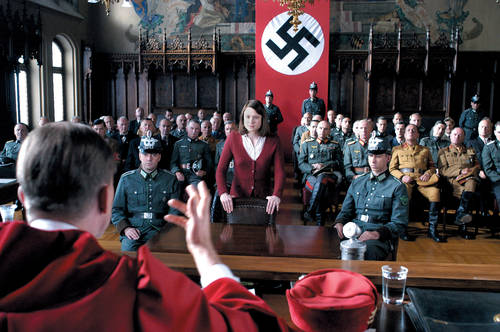
Set in Munich 1943 a group of students known as The White Rose publish leaflets and daub graffiti on walls calling for an end to the war and the overthrow of Hitler. Their means are always peaceful, but the campus is full of informers and the Gestapo are everywhere. Sophie Scholl is a leading member of the group. The film tells her story over the course of six days after she is seen by a janitor at the university distributing seditious leaflets. The story is told from her perspective and we know only what she knows and see only what she sees. Julia Jentsch plays the title role in a strong performance and this film is further evidence of the healthy and dynamic state that German film-making is in these days. It's very very good - it was nominated for the best foreign language film Oscar in 2005.

As Sophie is interrogated the camera goes in close on her hand wringing as she duels with the investigator who is seeking her confession and the names of her accomplices. We see that her interrogator notices her body language, but we are never given an indication of how he reads it. She is at times economical with the truth and invents alibis - but the stakes are high. She argues that the National Socialists (Nazis) who came to power on the back of laws allowing them free expression cannot then deny German people free expression if they disagree with the state line.

Sophie and her brother are charged with high treason and after her brother finally confesses so does she. In the ongoing interrogation she pits her will against Nazi ideology and her interrogator has to perform impossible intellectual gymnastics that defy logic simply to create an answer the force of which lies solely in the fact that he can shout more loudly than her. Sophie's quest is for freedom of thought and expression, for an end to the killing of women and children, an end to the death camps, an end to blind and unthinking fascism. Her interrogator can only see a return to Germany being the down-at-heel puppy dog to the rest of the world as he refers to the "stinking" Versailles Treaty which gave rise to the Weimar Republic.

In the end she signs her own confession and the consequences are inevitable. The court and judge are shown to the epitome of the caricature you would expect. Sophie, her brother and a third accomplice are beheaded that same day. Brutal. But then war is. Blessed are the peacemakers. Blessed is Sophie Scholl.

An important story - one to set alongside Valkyrie.

As a story 11/10. As a film 7/10.

Creation


I had been avoiding this film because I was fearful it would indiscriminately side with the evolutionists or creationists. What a mistake I made. It is a film that captures the anguish of a dawning realisation that all the facts point to something which will challenge the status quo in such a way as there will be no return. This is not a film that depicts Darwin as the wilful destroyer of Christendom, but as a loving father, husband and scientist driven by the need to find answers. Darwin was no saint - but neither was he any more a sinner than you or I.

My own preconceptions had blinded me. I was delighted to be transported to the world of real scientific discovery and exploration. To a place where someone could think completely original thoughts and over time see them evolve into a coherent system that allowed a new understanding of the world around us to coalesce and blossom as The Origin of Species.

One thing that film makes patently clear is the cost to Darwin and his family of the pathway his vocation forced him to follow. He was right to be angry with the local vicar for cruelly punishing his daughter by making her kneel on rock salt until she repented. His loss of faith and his desire to seek a common understanding with his wife who maintained hers is an exquisitely choreographed ballet wrought with emotional tension, guilt and ultimately forgiveness and acceptance.

This film moved me to cry at two points. Once because of a generous reconciliation between his second daughter and Darwin and once because in Jennifer Connelly's portrayal of Emma, his wife, I saw displayed such gracious and generous characteristics as I have only previously seen exhibited by my wife! For me this underlines the fact that this is film not so much about philosophical idealism but about relationships. Of course it touches on the intellectual battles that were being fought and this is evidenced by the ongoing correspondence and meetings with Huxley and Hooker. Whilst that may be the vehicle that provides the story's means of mobility, the landscape through which it travels is a landscape of relationships.

I would happily have watched it again immediately. I cannot remember when I last felt like that about a film. If you've not seen it, put it on your list.

I'll give it 7.5/10.

Monday, 1 November 2010

Watching movies among the books


Today I am off to North Wales and the village of Hawarden where the great British Statesman William Gladstone lived. He built this little place to accommodate his library which is now in excess of 250,000 volumes. As well as offering a great opportunity for academic research and good B&B, the centre also runs courses across a number of disciplines. The Warden, Peter Francis, is heavily into reading films as theological texts so it's no surprsie that twice a year courses on film feature in the programme.

So, I am shortly to depart with a good friend and colleague who shares my passion for films and God, so it should be a good time. The programme lists the films set out below. Sometimes an introductory talk is offered to help set the context without giving too much away. Afterwards, we always reflect on and discuss each film. Peter runs the course with long-time friend Tom Aitken who among other things was one-time film critic for The Tablet.

Films of Faith & Doubt
  • He Who Must Die
  • Creation
  • Sophie Scholl
  • Keep Walking
  • The Devil and Daniel Webster
  • Keeping the Faith
I have stolen the format (but not the content) for a course I will be running at the Diocese of Winchester's Retreat and Conference Centre - Old Alresford Place from 29 Nov - 1 Dec. Places are still available. Contact me for further details.

I hope to be offering my reflections on these films.

Sunday, 31 October 2010

Africa United


All right, this film does have some serious shortcomings in terms of story and script - but it will leave you with a warm smile on the inside. Some have dubbed it an African Slumdog Millionaire - and this is a fair thing to say - but this one is easier on the eye.

This is a 'road trip' movie - that is, the story is told in part by the journey the characters undertake. It is also a story within a story within a story. It is simply told and the main five characters are all children - from three different countries. This is not a film about football - it begins with Dudu showing us how to make a football out of a condom and yes it ends at ... well I won't spoil it for you.

The condom is present because HIV/AIDS is one of the threads that weaves the story. Another is child sex workers, a third is refugees, a fourth is child soldiers and war, an another gives a wonderful picture of Zimbabwe's economy going down the drain as some of its banknotes head towards Victoria Falls.

The plot is as unlikely as the characters are likeable. That doesn't matter. What does matter is the warmth and ingenuity displayed by the members of 'Team Africa'. This draws the viewer in and is quite simply irresistible.

Some of the threads of the story remain undeveloped whilst others are present throughout. This for me was disappointing. It was almost as though the film-makers lost their nerve. Maybe it was a limitation imposed by working with so many children. However, the ending is bitter-sweet as one of the threads works inexorably towards its horrible conclusion.

Do go and see this - it's immense and will in time become a sleeper hit I'm sure. In five year's time most homes will have this on DVD!

I'll give it 7/10.

Tuesday, 12 October 2010

Alamar


If you had the chance of being brought up as a kid in the Eternal City of Rome, that would seem like a good option - to most people. This documentary explores the contrast between life in Rome and a radical alternative - in reality it only explores the alternative! Jorge of Mayan decent and Italian Roberta were together for three and a half years and while it lasted it was unbelievable. The relationship even spawned Natan - a likeable and innocent boy who has spent most of his life with his mother in Rome. Thankfully the couple parted amicably and arrangements are made for Natan to spend some time with his father - who lives on the jungle coast of Mexico where he, like his father, is a fisherman.

At first the transition from Roman apartment to shack on stilts in the sea and the all-pervasiveness of water overwhelm Natan. But as he accompanies his father and grandfather on fishing trips, his confidence begins to grow and he develops physically into a boy who knows how to play, wrestle and generally be a boy. Jorge is both a good father and a good teacher. Life in the shack is pretty spartan and the diet is okay - as long as you like fish. Interest is provided by the wildlife - Frigate Birds, crocodiles, seagulls, a cattle ibis named Blanquita and of course many many fish.

As the film progresses we are invited to slow down and synchronise our being with the rhythm and pace of life as a fisherman on Mexico's huge Caribbean reef off the Yucatan Peninsula. The relentless pounding over the waves in the boat. The tranquil and vibrant beauty of the reef and it's fish which is shattered when end up on the spear-tips of Jorge and his father. The birds and crocodile feeding on the waste when the fish are gutted on the shack verandah. The Cattle Ibis who helpfully allows herself to be adopted so that she can clean up the cockroaches. A wonderful observation of a complex and sustainable ecosystem.

In some ways this film echoes The Wind Will Carry Us and if you like action chases, the only kind in this film are as the fish try to evade capture. At the end of the day, Natan gains an education no school in Italy could provide. He also learns the importance of the tradition his father maintains. But as with all good things, Natan must return to the Eternal City. Perhaps eternity isn't always everything it's cracked up to be?

The best way to describe this experience is to quote part of review by someone on the Internet Movie Data Base (IMDB) - a review by someone who has not quite mastered the technique of reflection: "I saw this movie with a friend who is a native Mexican. We both were bored stiff! We both kept waiting from something to happen, but nothing did.". If only she had eyes to see!

I caught this as a one-off showing in my local Art-House cinema in Southampton today. Try and check it out if you can - you will be rewarded.

I'll give it 7/10.

Sunday, 10 October 2010

Social Network

(Screenshot 'borrowed' from the official site)

I went to see Social Network this morning as a free preview screening at my local art house cinema in Winchester courtesy of Showfilmfirst. Thanks guys.

I must say that I am a reflector - I find spontaneous reaction to things hard and prefer to understand things and mull them over before I respond. This film has got me so buzzing, I'm writing this the same day!

This is the story of the creation of facebook and the disputes that followed as it blossomed into a multi-billion dollar business. Set in Harvard University in Boston in the early noughties, it tells the story of genius Mark Zuckerberg. As is common with many folk who also happen to be a genius, Zuckerberg seems to score on the autism scale in terms of his difficulty in behaving appropriately in his relationships. Whilst the story is about facebook - the social networking site, it is also cleverly about the social networks and their varying degrees of functionality that spawned this behemoth. The Harvard Colleges and exclusive clubs, the have's and the have not's, those in relationship and those longing for one. The way the narrative unfurls demonstrates the very medium that the story is about - Zeitgeist personified!

I was expecting a geeky mutual love-fest with nerds and hard-nosed business types. What I watched was an utterly gripping and compelling portrayal of the messiness of creativity at work. The characterisations are immensely strong - easy to believe and totally convincing. The juxtaposition of Harvard - old-school, back East and the seat of sound ideas - over and against Palo Alto California where anything is possible and to where ideas must migrate if they are to be given life and succeed - is a reflection of the paradigm shift that echoes the demise of quill and ink in the face of the hegemony of WiFi and e-commerce.

Much of the film is set in the context of the two law suits Mark Zuckerberg defended. These are spliced seamlessly with the unravelling story as facebook grows and develops into the ubiquitous force it has become around the world today. Throughout is a painfully engaging portrayal of Zuckerberg as he struggles to hold together the relationships necessary to make the enterprise work. It is as though his abilities in programming and social network conceptualisation in the virtual world are inversely proportionate to his ability to sustain social networks in the real world. This, together with the fact that he is at heart a 'good person' endears him to movie-goers. A genius who is genuinely disinterested in wealth, notoriety and prestige, but who struggles with people. Zuckerberg only had one true friend in the story and even they end up in a legal confrontation.

As a piece of social history, recent history, this is a must-see film. The facebook generation are the ones beginning to run our planet - any insights into what drives them are valuable. As a piece of compelling drama of the highest quality, this is a must-see movie. As a portrayal of genius and the inability to relate appropriately, it is a must-see movie. I think you should go and see it!

I'll give it 9/10 and I'd happily see it again tomorrow! Can't wait for the bluray.

Thursday, 7 October 2010

The Infidel


The plot is very simple and the potential for it to descend into farce is ever present. The story, written by David Baddiel, is however cleverly carried by Omid Djalili and the supporting cast. To explore the tension between an individual's identity as a Jew or a Muslim and to generate laughter is evidence of striking a good balance in the face of fundamentalist hate that is the more usual polemic for explorations of this taboo topic.

More than exploring what it means to be a Muslim or Jewish, the film is a vehicle for Djalili's character to explore his own sense of identity - a road trip around the mosques and synagogues of East London. Inherent within the story is the tension between a liberal approach to faith and a more fundamentalist position. For those who have ears to hear and eyes to see, the film raises many questions and through them issues an invitation for us to examine our own sense of belonging and self-identity.

One of my early posts on this blog was about the film Notes of a Scandal in which I confessed to having great difficulty in watching films that convey deceit. I find it difficult to stick with them as they make me feel very uncomfortable. I'm not sure why. I simply know that deception and lying are perhaps the things I find hardest to accommodate and to see them as vehicles for a film's story puts me off the film. There is a good deal of deceit in this film - for very understandable reasons, but the tension it created for me meant I had to stop it half way through for a break! Yes I know, I need therapy to get over it. No doubt I suffered badly as a child and this has been imprinted deeply into my psyche. Trouble is, it's buried so deep I can't remember it!

An added bonus of the film is the dimension created by exploring 'Jewishness' and 'Muslimness' in a third culture of East end London. The interplay between the cultures, their motifs and values give a welcome development of what might otherwise be a stodgy and predictable story. It also allows an exploration of how much of a religion's manifestation in any particular place is an expression of the religion itself and how much of it is a function of the culture the religion originated in and also subsequently finds itself in.

I would recommend you give this a try - particularly if a comedic approach to religion is not your usual cup of tea. I'll give it 6.5/10.

Saturday, 18 September 2010

On holiday

Sorry nothing's happening - I'm on holiday in the frozen and wets expanses of the Highlands of Scotland - not seen a cinema in 10 days!

Monday, 30 August 2010

The Wind Will Carry Us


This is my first encounter with Iranian Director Kiarostami. This is not a movie in any conventional understanding of the term. There is no plot or story as such. It's more reality TV than Hollywood blockbuster, it has no international stars and no identifiable outcome - and that is the master-stroke. Rather than presenting a narrative, this film presents life and invites you to develop your own story.

Set in a remote Kurdish village in Western Iran, this film is a mystery. Those within it are a mystery. The motive of the visitors from Tehran is a mystery. What happens to them while they are in the village is a mystery. The outcome is a mystery. What each viewer takes from this film is a mystery that needs to undergo gestation in the privacy of individual reflection. The film is an invitation to examine matters of life and death, the rhythm of life, what is important and who is important. It also invites you to slow down and readjust your perspective. The film offers a gift - an opportunity for healing, celebration and a re-evaluation of priorities.

Descending on this remote settlement the visitors are received with customary hospitality. Their mission being to film the ancient and obscure mourning ritual of this people. Connected to the wider world by only a mobile phone through which daily requests for progress reports come, 'The Engineer' and his colleagues (who we never see) wait and wait - interested only in the health of the village Matriarch who is thought to be close to death - but she is only ill. The irony is that to receive a signal for the phone, 'The Engineer' has to drive out of the village to the hill-top cemetery where a local is digging a grave - possibly for the old lady.

As the waiting goes on, so the rhythm of village life proceeds unabated. The visitors never really integrating, the hospitality of the villagers able to be welcoming whilst maintaining a distance. Gradually it dawns on 'The Engineer' that there of things of greater value here than the assignment that brought them to this village. He recites poems - one to a suggestively beautiful girl who refuses to show her face as she milks the cow for him. Iranian culture has a proud and lively heritage of poetry that remains current, drawing on work from Omar Khayyám and Forough Farrokhzad to name but two. 'The Engineer' experiences moments of enlightenment through encounters with a Tortoise, a Dung Beetle and the local Doctor!

At the end of watching this film I was left asking 'what was all that about?'. The more I have reflected on it and discussed it with my ever-insightful significant other, the more I am beginning to see this as a film about what it is to be human and connected to the environment lived in. It is a film about life, about what matters and ultimately about death. As the words of the poets reach out to us down through the centuries, we are reminded that our existence can transcend our three score years and ten.

It is interesting to note that it falls within the Arts & Faith top 100 spiritual films - at number 57.

When you want to be challengingly engaged - watch this film. I'll give it 7.5/10

Sunday, 29 August 2010

The Girl Who Played With Fire


The second in the Steig Larson Millennium Trilogy arrived in cinemas this weekend. The book sales may still be extremely healthy - have you travelled on London's underground lately? - but the critics seem to have been sharpening their claws in anticipation. Despite that, this film has had a juggernaut of publicity pushing it into the public consciousness and with a 15 certificate is more likely to reach a wider audience.

Critics and to some extent the movie-going public seem to demand more of a second film in a trilogy than the first delivered - particularly so when the first film breaks important ground in some cinematographic way - like The Matrix trilogy for example. It is true that a lot of the intrigue aroused by the first film centred on the character of Lisbeth Salander played by Noomi Rapace. The question then is how do you develop the character in a meaningful way whilst having a plot that makes sense and gives continuity with the first film? The answer is to begin unpeeling some of the layers that encase the complex character that is Salander. Why was she such a striking and troubled person in the first film? What gave her cause to hate men - Women who hate men being the Swedish title of the first film?

The story is about abuse of power - expressed in sexual activity. This film manges to present five sex scenes - two of them mutually consensual, three of them involving masochistic bondage and abuse - what is it with Swedish men - or are they archetypes? This film has a different director whose style is in stark contrast to the first film - that makes it visually a very different proposition. This film is shot much more in close-up using steady-cams and whilst some plot devices are telegraphed - like seeing the name on a wheelie bin outside a house to show us who owns it, others are completely absent like how did Blomquist know where in Malmo to look for Salander?

There is certainly plenty of action in this film. Too much violence and more than enough blood. This time, these features are an over-indulgence. This does detract from the viewing experience. Too many plot devices are borrowed from James Bond movies - this too exhibits a lack of originality. However, overall the film is still excellent and I am already looking forward to The Girl Who Kicked the Hornet's Nest!

For me the story is about how a young girl who dares to take on her abusive father who enjoys immunity from Swedish law and as a result is herself abusively institutionalised, comes to terms with that as an adult. Salander is intellectually sharp. She is blessed, or cursed, with a photographic memory which perhaps too often triggers vivid flashbacks. Her computer hacking and investigative skills are again to the fore. The story in this second instalment of the trilogy is all about explaining how Lisbeth Salander got to be the person we were introduced to in the first film. It tells this story very well and sets things up well for the finale.

I am told by those who have read the books that the transition to film is very faithful - perhaps that's why this is another long film? If you can stomach blood and physical violence - go and see it. That is easier to watch than the violation of the young Lisbeth Salander and its consequences.

I give this 7.5/10.

Monday, 23 August 2010

Wall-e


The Disney Pixar stable is currently producing films that are engaging, well scripted and visually stunning. Wall-e is no exception.

Set in the 2700 century, earth has been ravished by junk and Wall-e is a robot tasked with clearing up the place ready for the return of the giant spaceship Axiom carrying thousands of people ready to repopulate the earth when life is once again viable. Periodically the Axiom sends out a probe and when one named Eve discovers a plant Wall-E found growing in a fridge, it not only sparks a relationship between the two robots (!), but also eventually leads to the return of the Axiom and the recolonisation of the planet. In the meantime, the passengers on board the axiom have all become grossly obese and unable to move under their own power.

So what's the film about? It's about the potential to abuse our planet. It's about 'unnatural love'. It's about obesity and excess. It's also about the dangers of AI taking over and making wrong crucial decisions on behalf of humanity. It's about the Axiom being seen as an Ark in the style of Noah.

The joy of this film is not the individual component story lines but how they are all scripted together and then presented in vibrant and dynamic animation. The film also openly plays homage to a number of sci-fi films and series - 2001 where Sigourney Weaver supplies the voice for the equivalent of HAL, Wall-e's journey to the Axiom mirrors the opening Titles of Star Trek Voyager - I could go on, but that would spoil your fun.

Yes it's also about paradise lost - paradise found. It's about the rediscovery of what it is to be human, It's about love, power, fear and hope - primal emotions that will connect with anyone. This film has universal appeal as well as a U Certificate! I found it deeply engaging, well made and entertaining - and in this department it refreshingly avoided clichés and used comic timing to offer something different that still made me laugh.

Well worth it. I'll give it 7.5/10.

Saturday, 21 August 2010

Camera Buff


Filip and Irenka are expecting their first child. They've recently moved into a new flat, they are happily married, Filip has a good job and then the baby arrives. At the age of 30 Filip has it all - he's even bought a Russian made 8mm film camera to film his new daughter growing up. The film is set in a small Polish town in 1979 in the communist era. The buildings, pavements, mud, sky and cars are all shades of anonymous grey. Colour is brought by the lives of the characters.

Filip's bosses discover he has a camera and ask him to film the 25th Jubilee celebrations as a record for the factory. Filip's initial attempts are clumsy and he is always in the way. However, he has a nose for what makes good cinema and follows his instinct which brings into conflict with the factory's Director. This conflict is ongoing as Filip develops his own creative documentary style peppered with flashes of creative interludes. Such is the paucity of film making in Poland that Filip is invited to enter the film in a national film festival where he wins third prize. This inflames his addiction to film making and he forms a film making club with his colleagues.

Filip's new-found celebrity and increasing addiction begin to force a wedge between him and Irenka who is struggling after the birth of their daughter. He films their daughter as she has her nappy changed  and Irenka chastises Filip for filming the new baby in its nakedness. Filip engages in new projects, flirts with a national film celebrity who is well-connected and eventually lands a commission from national TV. All of these serve to unwillingly push him and Irenka further apart. Filip does not want this but as with any addiction is powerless to stop it. Eventually his wife leaves him to go and stay with her mother.

Filip's film making style is documentary - he wants to portray things as they are. He uses the camera to expose what he considers to be institutional corruption when he films behind the façade of the town's buildings to reveal the decay and squalor the towns folk actually live in. This film brings great acclaim and Filip embarks on filming workers from the local brick works who have not been producing bricks for some months because of a shortage of supplies - instead they have been sent around the town to tidy it up. This brings him into a direct conflict with his work's Director again - a suitably rotund and comparatively well-dressed man in a stereotypical portrayal of the communist anomaly that some are more equal than others. He explains to Filip that funds given to the town to improve its buildings were diverted into projects for a much needed hospital and nursery and that Filip is not presenting the true reality because people in his position don't understand full picture. Central authorities become unhappy with Filip's portrayal of ordinary life and cut off funding to the town. Some of Filip's colleagues are made redundant as a consequence of his activities.

Filip experiences an epiphany and races to the station to recover the brick works film before it goes off to the TV company. Dramatically he opens the canister and throws the spool down the street unwinding the undeveloped negative and exposing it to the light thereby ruining it. This mirrors his own conscience and understanding having been exposed but his friend cannot understand his actions - that Filip has learned the responsibility that accompanies using a lens to provide an interpretation of what the camera sees. He has learnt the power of story - it's power to inspire, to represent and misrepresent, to engage in a moral crusade the unintended consequences of which bring greater harm on others and his community.

This film is semi auto-biographical of its director Krzysztof Kieslowski. It is a powerful film that sets out the responsibilities film makers - and creators of art - have. His addiction to tell the truth in a creative way cost him his marriage, his colleagues their jobs, his town its redevelopment. It is little wonder that Kieslowski was always wary of institutional authority and that this is a recurring theme in his films. This film was his first feature length drama and it established him on the main stage of film making. As with all Kieslowski films it explores the moral and emotional dynamics of the characters. It is possible to say that in following his new-found vocation as a film maker, Filip lost his vocation as a husband, father and resposnsible colleague.

The power to be creative is gripping and can become all-consuming. We are after-all made in the image of God who is the Great Creator. The film invites us to reflect on commitment, morality, vocation and self-sacrifice. Is it right that 'art' can drive all of these things from us and turn us into something new? What happens when we find fulfilment in these things but lose everything else? The film ends in a way as it began. Filip turns the camera on himself and we see his face reflected in the lens - he is alone, naked, now he is the subject of scrutiny by the camera - just like his little daughter was.

A first class film. I'll give 8.5/10.

Sunday, 15 August 2010

The Savages


This is a brave film that deals with the subject of dementia head-on. The sleeve notes describe this film as 'hysterically funny and irreverent', I found it to be neither. It is realistic, gritty and it recognises that there are no perfect solutions when dealing with a messy subject like this. The story explores obligation, guilt and a host of other emotions as it seeks an understanding of what is meaningful and what is not.

Lennie Savage lives with his 'girlfriend' of 20 years in Sun City, Arizona. His behaviour is getting more extreme and the carer who comes in to look after his partner provokes an incident that sets in train a series of events. The first one being that Lennie's partner dies whilst having a manicure in a Beauty Parlour. Her children cite a legal agreement made by the seniors that neither would have any call on each others possessions at any stage in the future and they 'evict' Lenny so that they can sell the house. Even at this point in the film it is worth reflecting on the image of retirement that sun City presents - manicured and synthetic.

Lenny's children - both around the 40 year-old mark are then brought into the picture. Jon is a College Professor living in Buffalo, up-state New York. He is in a relationship with a Polish girl but her visa has expired and she has to return to Poland. He cannot commit to marriage and muddles on through this messy and dysfunctional relationship. Wendy is also single. She lives in a grubby apartment in New York City and works as a temp to sustain her real passion as a playwright. Wendy is in what appears to be a long-term affair with a married man who is facing his own mid-life crisis. She craves attention and intimacy, he craves sex. Another dysfunctional relationship.

Jon, the elder of the two, always takes the lead and is presented as the rational, logical sibling. Wendy is always portrayed as the one rooted in the fantasy dream-world of possibilities, unable to deal with hard realities confronting her. The two siblings, clearly struggling to develop their own fulfilling relationship with one another, battle the emotional and mental wounds inflicted in their childhood at the hands of Lenny and the absent Mom to fulfil their sense of obligation towards their now confused and ageing father.

There are a number of small moments when the curtain is pulled back and light floods in. When Wendy is mechanically having sex with her lover and instead of concentrating on the moment - or her lover - she reaches out to his ailing Labrador for a sign of affection. Jon, delivering a class on Bertolt Brecht encounters the distinctions he is outlining in his lecture played out in his life as he receives a phone call. Or when Wendy is taken seriously by Jimmy, a carer in Lenny's Nursing Home, her only means of responding is to grab him and kiss him passionately. There are many more.

The film invites you to make parallels with your own situation - your childhood, family dys/functionality and outlook for your parents. I am an only child so I missed out on squabbling sibling rivalry - something I've always regretted. Both my parents are long dead and so I was never faced with the spectre of dementia - although through my work I have encountered it many times. What I could readily tap into were the feelings of obligation and guilt that being a member of a family automatically engender. The story also invites you to side with either Jon or Wendy - the realist or dreamer. Perhaps my characterisation of them betrays whose side I am on!

The film raises wider questions of how dysfunctional families who are geographically dispersed and who are unable to create and sustain new and meaningful relationships for themselves should function when circumstances throw them back into a tight-knit situation. It would have been easy for Jon and Wendy to say we've not seen Dad in 20 years and Mom in longer - let welfare take care of him. But they didn't. They did what they could and Jon's pragmatism recognised that Lenny needed specialist care - care beyond their ability to deliver. The compromise wasn't perfect - but it gave them more than they had before. Is this a realistic and best hoped-for-outcome?

Much of the story is brought into focus as Jon views a rehearsal of one of Wendy's plays. It's subversive auto-biographical angle sheds light on how the Savages got to be where they are.

Life is messy.

Excellent acting from Philip Seymour-Hoffman and Laura Linney. A film to get under your skin - whatever your age. If it prompts you to make preparations now while all stake-holders can own the outcome we can receive it as gift. If this is too much to ask for, we can enjoy it as a gentle comedy that peels the veneer off living with dementia.

Go watch it - you'll be rewarded. I'm giving it 8/10.

Saturday, 7 August 2010

Book of Eli


A story of pilgrimage, hope and faith in the midst of a post-apocalyptic USA. Thirty years after the end of the war the USA is a wasteland with gangs of armed marauders ready to bush-whack anyone they encounter to steal their shoes, water or even just for the fun of it. Eli has been heading West for 30 years. He heard a voice that led him to a book and which then told him to take it to the West - to a receptive community. He only seeks a peaceful passage as he continues on his pilgrimage but if anyone stands in his way he is prepared to kill - not to save his own life, but to preserve the book and ensure it reaches it's final destination.

Okay, so the film is largely a pretext for Denzel Washington to engage in lots of armed combat against impossible odds. There are a number of cool fight scenes - with some wonderful Matrix-type camera work on one or two of them.

The narrative offers the opportunity to explore what the rules are in a rule-less world. The invitation is declined and the bloodfest continues. Given the nature of the book Eli is transporting, this has to be a wasted opportunity.

The narrative is also unable to resist pairing the hero up with a female - although nothing romantically comes of it. However, Solara does manage to mysteriously escape from a cave she is locked in and she does show initiative and guile in helping speed Eli on his journey making it end all too quickly - seeing that it took him 30 years to get that far!

I won't spoil it by saying where they end up, but the fact that it is a 'secure and isolated' community begs lots of questions about the freedom the book is supposedly meant to offer. The movie might prompt questions about the nature of calling, (blind) faith and pilgrimage if the viewer is sensitive to them but for me these were played too softly. Solara's mother is blind and where/how/why did Eli learn the language of the book?

Whilst the combat scenes are visually gratifying, I found little else to commend this film - it played everything that could be engaging way too soft. Too much of Eli's back story is missing so there is no meaningful context to the journey he is on.

I'll give it 5/10.

Thursday, 5 August 2010

Strangers on a Train


It starts with a shriek of a train whistle...and ends with shrieking excitement. The marketing tag-line from 60 years ago. They don't make them like this any more!

It's good to interweave some classics in between the newer block-busters. Last night we watched this Hitchcock thriller. It kept us on the edge of our seats right until the very end. The skill of the film is not only in the its story-telling but also in its characterisation and how those characters draw you in. The film begs you to make judgements and ally yourself with the one or more of the characters. The opening sequence shows two men arriving at a Railway Station by taxi. All we see is their luggage and their feet as they walk to the train. We follow their feet down the carriage. One man clad in black and white brogues reminiscent of the Gatsby era, the other in smart plain, but quality shoes. This passage of the film forces you to construct your profile of who the shoes, legs and luggage belong to. Before you even see them in the film, you've fabricated a sketch of the two men in your mind. The whole film is a mind-job which explores hate, love, the need to escape the bonds of relationship, guilt, psychosis and the most laid back and patient Police force in the USA! It prompts the question - 'what would you have done?".

It is not until the two pairs of feet sit opposite one another and one accidentally kicks the other as he crosses his legs and so has cause to speak, that we are allowed to see the two men in full. Both are dressed smartly in suit and tie. Both appear to be in their 20's or early 30's at most. One quiet, a man who prefers to keep himself to himself and read. The other talkative, over-familiar, invasive, controlling and domineering.

The ostentatious gabler (Anthony) - the one with the two-tone brogues - recognises the quiet man (Haines) as a leading tennis player. As he himself is a socialite, he is aware of Haines marital situation. Haines' wife Miriam has been playing loose while her husband has been on the tennis circuit. Subsequently he has hooked up with Anne, the daughter of a Senator, whom he plans to marry once the divorce from Miriam comes through.

Anthony lives under the shadow of his father who is constantly disappointed by his son. As Anthony sees it, both he and Haines have motive to murder to escape from their respective relational prisons. The only problem is that both would be found out. But as they have had a chance encounter on a train why not commit each other's murder and so both be set free without fear of implication! Anthony makes the proposition in terms of prefixing each sentence with 'just suppose ...' whilst Haines thinks he is simply accommodating a nutty and imaginative nuisance. They part.

Few of the characters in the film are neutral - you are forced to make judgements and to like them or not. Miriam is a nasty piece of work. A good-time gal, pregnant with someone else's baby, she threatens to withdraw from the divorce, and live with Haines in Washington bringing the baby up as his child. It could be argued that with Haines enjoying the tennis circuit, he should have made better provision for his wife. Instead of going to see her attorney to finalise the divorce, they argue and Miriam threatens Haines with no divorce.

Anthony, who is shown to be psychotic, considers that an agreement was reached and so he plots to kill Miriam. This he does by strangulation on an island in the tunnel of love boat ride in an amusement park. That evening he confronts Haines, hands over Miriam's broken glasses as proof and demands his quid-pro-quo. Despite Haines' best efforts to fob Anthony off, Anthony's persistence proves troublesome - particularly as the Police are trailing Haines 24/7 as they suspect him of complicity in his wife's murder. The situation isn't helped when it transpires that Anthony moves in similar social circles to Haines' intended Anne and so they keep encountering one another. Anne becomes suspicious and the story takes on an even more sinister twist when Anthony sees Miriam in the face of Anne's sister Barbara (played by Hitchcock's daughter Pat) at a party just when he is demonstrating the ease of strangling someone on an older party-goer whom he nearly kills as he goes into a trance.

The film is brilliantly paced. It is 96 minutes long. Miriam is murdered after 30 minutes. Haines seeks to bring about a conclusion on 60 minutes and the final death occurs on 90 minutes. I won't spoil it by saying how it ends - but the end is pure Hitckcock. You will never see a merry-go-round in quite the same way ever again!

This is a really excellent film. It maintains suspense and momentum throughout through great Direction and very good acting. The way in which the viewer is forced to adopt sides, make character judgements and think 'what would I do?" all serve to demonstrate how effectively the film draws you in and engages. Sixty years on, this black and white masterpiece can hold it's head high against the biggest 3D CGI blockbuster.

I'll give it 8/10.

Monday, 2 August 2010

Valkyrie


A story that needed to be told - and needs to be retold, often.

Based on a true story, this film rightly has an all-star cast led by Tom Cruise (Von Staufenberg)in a performance that is every bit a good as A Few Good Men. Tom Hollander who is currently starring in BBC TV's Rev gives a good performance as does Eddie Izzard who plays a Nazi General! Bill Nighy, also playing a General, inhabits a role he has made his own in countless TV dramas and movies - indecisive, lacking in confidence, a wimp of a man whose greyness is only outdone by his lack of conviction. Carice van Houten also turns in a worthy performance as Cruise's wife.

The story opens with the sound of hundreds of soldiers taking the oath of absolute allegiance to Hitler. It then switches to North Africa with Von Stuafenberg making an entry in a personal diary where he decries the scale of the loss of life and the blindness of those leading his country. Shortly afterwards his unit comes under British fighter attack and he is wounded resulting in the loss of an eye, a hand and two fingers. He is reassigned to Berlin and a desk job.

His views about the Nazi leadership being known, he quickly falls in with a group plotting to overthrow Hitler and negotiate an immediate cease-fire with the advancing allies. Together they plot to blow up Hitler in his bunker and trigger Operation Valkyrie. Valkyrie is a standing order to mobilise the German reserve army to defend the homeland. There are turns and twists along the way, so I won't spoil the story or the outcome. The narrative is largely believable and suspense is well maintained throughout.

The story and context raise all kinds of questions about 'just war' and how those opposed to their national leaders should act. It is hard to ask whether those involved in this plot could or should have done more. For me their odds of surviving such an attempt were always low so would a more direct suicide mission have improved the chance of a successful outcome? It's so easy to ask that of someone else. What would I have done - what would you have done?

Hindsight always gives us 20-20 vision. At the time with the real and present pressures, not really knowing who could be trusted and who might betray you, not many would have had the courage to follow their convictions. The film fittingly ends with the inscription from the resistance memorial in Berlin.

A good story of heroism and courage that is well told. I'll give it 7/10.

Friday, 30 July 2010

Inception

'Buckle your seat belt Dorothy, 'cause Kansas is is going bye-bye.'


Wow! Inception is a stylised collision of Bourne meeting the The Matrix.

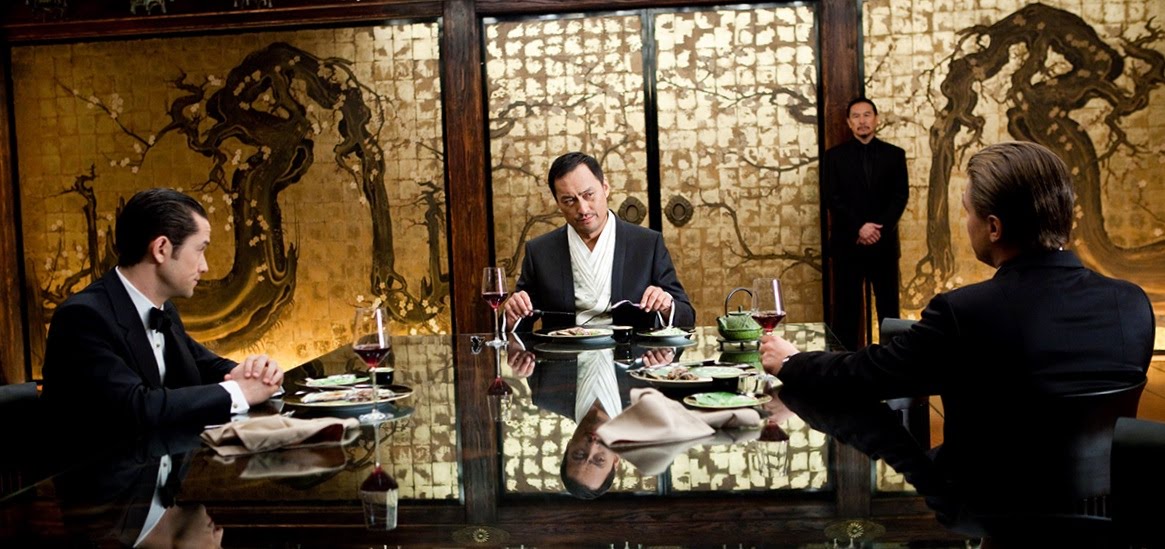
Cobb is on top of his game - the best there is. In becoming the best he has journeyed to places no-one wants to see and feelings of guilt, remorse and his need of redemption are the emotions that drive this story. Written and directed by Christopher Nolan this was never going to be a straight forward walk-in-the-park kind of film. The ensemble cast perform very well together - DiCaprio inhabits a rich vein of performing talent at the moment and his character (Cobb) drives the narrative. Ellen Page (Ariadne) and Tom Hardy (Eames) are also particularly impressive. The story conceptualisation is worthy of award nomination as is the consistent application of CGI which unifies the five dimensions or worlds the story simultaneously unravels through.

Cobb is a thief. His area of expertise is applying a form of military intelligence gathering come interrogation technology to the world of corporate espionage. The technology links people connected to a machine who are able to share a dream together. The dreamer is the architect of the dream which is populated by manifestations of the dreamers sub-concious over which of course they have no control. Encounters within this dream world are used to delve deep into co-dreamers minds to extract secrets, plant lies and whatever else the pay-master desires - inception. The trick is to render the 'target' unconscious in the real world - sometimes enhanced by sedatives for a deeper dreaming experience - and then hook them up  to the machine. 

In a dream an hour in real-world time lasts 10 hours in the dream enabling much to accomplished. Unless the target is trained or has anti-dream counter-measures in place, on waking they feel as though it was just a dream - but by then the damage has been done. Each dreamer fashions a totem that they always carry with them and can use to determine whether or not they are awake or dreaming.

Cobb once went too far with his wife (Mal) who through Cobb's accidental auto-suggestion lost the ability to distinguish between dream states and the real world locking her totem in a safe. She is stuck in Limbo - the deepest dream state with no clear prospect of escape. Cobb struggles to limit the intrusion of Mal from his sub-conscious into any dream that he is in but she always breaks through and wrecks his plans. Accused of her murder back home, Cobb is a global fugitive with many trying to track him down.

Cobb receives an invitation for one last final job of corporate espionage - the pay-off for him would be a wiping of the slate with the US authorities and the chance for him to return home to his two children - a lure too attractive to resist. I'm not going to describe how the story plays out but I will include a PLOT SPOILER about the end so only read on from here if you're happy with that.

Cobb travels the world to assemble a team for this ultimate job. Together they plot and determine that they need a dream that goes to a third level of dreaming - so deep it's just before the limbo state, a dream within a dream, within a dream. All of their planning can never anticipate the interventions that Mal brings to any dream that Cobb is in because she is such a strong part of Cobb's sub-conscious. Following the story is difficult enough without wild cards being played all the time! Suffice it to say that in the end Cobb needs to enter limbo to bring about the successful conclusion of the mission the team is on and to exorcise his own personal demons relating to Mal.

 PLOT SPOILER 

The film ends with Cobb returning to the USA and the family home. As he arrives in the kitchen he spins a brass top - Mel's totem . If it eventually stops spinning Cobb is in the real world, it doesn't, it's a dream. The children see him and run to him for an emotional reunion. As that the hugs and kisses continue, the camera pulls back to the spinning top. It hiccups and the screen goes black and the credits roll. Was it about to topple or was it simply a hiccup and it continues for ever? You decide - but I think the answer will come in the sequel that is now nicely set up.

Any story that forces us into the sub-conscious is an invitation to delve deeper than we would perhaps choose to do. What lurks in your sub-conscious? What regrets and fears do we carry with us every day? How do they manifest themselves when they invade the conscious world of our experience? How do you cope with that? If you could enter your sub-conscious and expunge your demons, would you? What price would you be willing to pay? What would be the consequences and would you be any less the person you were before or would be more integrated and so more of the true person you feel yourself to be? Films like this are invitations to screw with your inner workings. If you really want to do that, go and see a therapist.

A great film - well conceptualised, scripted, acted and shot. Go and see it - but take your totem with you!

I'll give it 9/10!

Wednesday, 28 July 2010

Miller's Crossing


I need to declare up front that I am a fan of the Coen brothers and the way they make films. This did not disappoint. It is a barn-stormer of a film in almost any way you wish to look at it. It may be 20 years old, but because it is set in a composite mythical world constructed from everyone's view of what 1930's gangster run prohibition USA was like, it connects in a way that refuses to let it age. The gentle browns of the colour palette and lighting espouse an almost sepia-toned reverence for a nostalgic golden age when men were men and women were there to do their bidding - and nothing more.

It is not a good film for a positive portrayal of gender roles. This is a very masculine film. There is only one female character and all other women are depicted as either floozies or servile receptionists. Verna is depicted as being as strong as any of the male characters and she is certainly as sharp as anyone in keeping up with the 'who is on which side' evolution of the story.

The iconic moment of the opening sequence pictures Tom's hat blowing to the ground where it rests momentarily before being blowing along a path in the woods at Miller's Crossing - a place at which pivotal events take place. It is reminiscent of the bag spiralling in the wind in American Beauty. It is also an image that haunts Tom - the central character. This is played on to good effect to heighten tension and suspense later on in the film.

The story is set in a an anonymous town enjoying the prosperity and technological advances of the age - trams, street lighting, telephones. The town is run by Leo - a Jewish gangster - who has the Mayor and Chief of Police in his pocket. Nothing happens in the town that doesn't make Leo money and it seems that everything in the town is centred on betting, drinking and maintaining Leo's position as top dog. All is well with the fraternity of Jewish, Italian and Irish mobsters in the town. That is until one of them feels he is being 'unfairly' cheated on.

That introduces the narrative's central theme of honour. As the Italian character Johnny Caspar repeats his mantra throughout the film, 'it's about ethics', we are taken on a grand tour that explores loyalty coming into conflict with the need to control, exert power, display trust and be entranced by love. Caspar has a beef with one of Leo's underlings that he feels isn't playing by the rules. That sets him on collision course with Leo and Tom advises Leo on how best to resolve the impasse to allow business to continue as usual. Leo chooses not to follow Tom's advice and sets up a series of confrontations that spark a mob war. As this unfolds, there are further plot twists revolving around Tom who has ongoing 'business' with Lazarre and Bernbaum - Verna's brother. Further fuel is added to this incendiary mix by the fact that both Leo and Tom are in a relationship with Verna and Leo wants to marry her.

Tom takes things into his own hands in an attempt to resolve things and restore a kind of peace - but it seems that he doesn't have a detailed plan as events repeatedly cause him to improvise and play one mobster off against the other on the fly. This means that Tom is out on his own and everyone feels they have a legitimate grievance against him. Does he set himself up as a crusading saviour seeking to restore equilibrium to a community in conflict and turmoil?

A striking feature of the film is the in-your-face technicolour comic book violence that owes more to the Batman TV series of the 60's and the A-Team of the 70's than reality - a hall mark of the Coen brothers. However, Tom chooses not to engage in physical violence and takes several beatings that if inflicted in the real world would have ruptured many internal organs. (He does once use a chair to defend himself.)

Non-violence in a violent world. Tom chooses to be violent in thought, intent and through provoking others to enact violence on one another. It is as though his inner world of scheming and plotting presents a reality which detaches him from the exterior - a world within a world. Perhaps this is a mirror of the film's central plot - that in a world of illicit gambling and drinking another world exists where the rules are clear, a morality understood and followed and where loyalty is the highest prize. A portrayal of purity in the midst of impurity. What this serves to underline are the dangers of a morality that is relativistic and which fails to acknowledge an exterior source of grace and wisdom. It is totally self-serving and ultimately becomes self-defeating.

The film is dense. By that I mean that it moves at an even pace and absolutely nothing is wasted - it demands complete attention. The acting is superb, the lighting and sets powerfully evocative of something that probably never existed - a simulacrum. The dialogue is pure Coen brothers - no wasted words and much meaning communicated in and through the spaces created by the Director and characters - especially Tom. Additional interest is added through the gay relationship between Dane and Mink which is presented in an open and matter-of-fact way.

I found this film gripping, excellent, convincing, repulsive and at the same time attractive with all the strength of an inescapable addiction. It communicated. Tom is a strong character but we know nothing of him except what we see him do - the same goes for all the characters, there is no back-story, no context. There is one scene where Tom chooses to exercise mercy and compassion. Are these things that inform his normal thought processes? For me it made Tom an even more believable and likeable character. It presented a glimpse of something that could transcend the moral ambiguity and bankruptcy of the narrative - it gave hope.

As a man I could understand and inhabit the world the film presented. It was like a favourite and warmly familiar overcoat that kept you warm. If this is the world as women encounter it, we are in deep doo doo and I am sorry for my complicity in it. Was Verna the only character with a consistent and life-giving morality? I wish to reassure you that I have no intentions of opening an illegal gambling and drinking den or of obtaining a Tommy gun and bumping off people who disagree with me, or playing by a relativist morality that is controlling and exploitative. There is much in this film to repulse the viewer - but this viewer would happily watch it again today - and possibly tomorrow too!

Well worth the investment of time - it will engage you. I'll give it 8.5/10.

Monday, 26 July 2010

Film Club


I have just finished reading the book Film Club by David Gilmour. A couple of years ago a colleague gave me a cutting from a Sunday Newspaper which was the story of a teenage boy who didn't do school. His Father made a bargain with him - he could live at home, rent free as long as long as he didn't do drugs and he agreed to watch 3 movies a week with his Father. This book charts those five years - it is autobiographical for David and his son Jesse.

The book operates in two spheres. Set in Toronto, the author works in TV and has a passion for film having once been Film Critic for CBS. He decides to use his knowledge of film, calling on reviews, books, interviews (sometimes his own) to enrol his son in a kind of Université de Cinéma and give him the education he wasn't getting in school.


The choices of films and his introductory sketches and retrospective analyses are all very apt. The story covers a huge range of genres citing 121 different titles. The insights the films give into Jesse's roller coaster of a life are at times helpful and at other times I felt lacking in sensitivity and positively unhelpful. I'm sure I would have done a worse job! Gilmour covers a breath-taking breadth by putting the spotlight on Directors, then on Actors, the way a film is shot, lighting. He highlights individual lines of dialogue and scenes that he feels resonate with Jesse's predicament. From James Dean's defiant swish of the rope in Giant to Patricia Arquette's motivational 'You're so cool' in True Romance, Gilmour tries to impute the self-confidence, la joie de vivre and lack of ambition his son's unfocused life lacks. I think he tries too hard.


The second sphere is the advice Gilmour gives his son about how to cope with broken romance - a pain that is an integral part of the human condition. The wrong assumption Gilmour makes is that together with the films, his previous romantic and sexual encounters provide all the data necessary to enable him to dispense the words he feels his son needs to hear. Naivete. Stuck in a seemingly endless loop of mismatch of communication ability, Gilmour's verbosity is inversely mirrored by Jesse's inability to articulate or express himself in any meaningful way. Eventually, Jesse does find an avenue to give expression to his hurts and feelings - and maybe even his fears. This confirms to the Father that the son has the greater talent. Jesse discovers the ability to be creative in way that communicates. I strongly feel that this one of the most basic human drives - stemming from the Trinity.


This is an interesting and well written book that tells an important story. My own passion for films and narrative as means of reflecting on daily life is, I hope, well documented on this blog. The book's ability to compel people to develop their own catalogue of films to educate people through is perhaps its lasting and most endearing legacy. What films would you choose - which have instructed you? How would use them? What would your hoped for outcome be? the question go on in the Université de Cinéma.


This is a good read - get yourself a copy.

Reel Issues

I have just completed work for The Bible Society on a study of Invictus. It will be published soon on the their Reel Issues site in the 'Epic' series - check it out.

Friday, 16 July 2010

Water


What's this all about then? Not as the title suggests 'water' - but that is an ever present theme uniting the different strands of the narrative. On one level it could be viewed as a docu-drama. Set in India in 1938 it could be seen as a record of how Hindu society treats widows - even when they are only 8 years old and their marriage hasn't been consummated. It could be seen as an Indian Romeo and Juliet - complete with balcony scene. It's also an interesting piece of social history as Gandhi's mantra is gaining popularity in the last days of the Raj. The film has very few sets, but those it uses it exploits to the full - particularly the waterfront shots in Varanasi. The film is beautifully lit and the camera work is stunning but at times it's very hard to decipher what is being said.

Chuyia is widowed at the age of 8 and in following custom she has her head shaven and is dressed in white. Her family arrange to take her to an Ashram on the banks of the Ganges where she will live out the rest of her life - widows will be cursed if they remarry. Her arrival has a big impact on the community and her feisty behaviour soon sets her against the leading widow Madhumati. To supplement the Ashram's income Madhumati lets the younger more beautiful widows out to sleep with local Brahmans whose attentions are considered a blessing. One of these widows is Kalyani.

Water is always present and the source is nearly always the Ganges (the well in the Ashram presumably shares the same water table). Whether it be for drinking, cooking, ritual cleansing, clothes washing or taking the dead away, bodily or in ashen form, water is the link.

 As the story follows life in the Ashram with all its ups and downs, which include Madhumati's drug taking and the death of an old widow, so we see a chance encounter between Kalyani and newly qualified idealistic lawyer Narayan, who has bought into Gandhi's philosophy. There is an immediate spark between Kalyani and Narayan and situations are engineered to ensure further encounters between the two sometimes using Chuyia as a go-between.

The story paints a stark contrast throughout by setting the traditions of the Ashram and Hindu society over and against the liberalising call of Gandhi and his followers who want to see India develop and move forward. This tension is personified in the developing love between Kalyani and Narayan. Eventually a decision is made and the film heads towards a climax - but there is a twist.

As I indicated earlier, you can watch this film on a number levels. It is a love story. It is social commentary and also an exploration of tradition being overturned by a liberalising trend. What stood out for me?

It is always very difficult to engage with a narrative that is set within and follows the values of a different culture. I have had the privilege of travelling to India many times and I love the country and her people. Time after time I would return home to asked 'what was it like?'. That is the hardest question to answer because the response begs for comparisons to be made. Making comparisons is all well and good when there is what anthropologists call a 'dynamic equivalent' - that is something that acts as a vehicle to allow understanding in one culture to be transferred, with meaning intact, to another culture. India is such a different kind of place that there are few dynamic equivalents - you simply cannot always describe things in India that make any kind of sense in the West. The cultures are too alien.

Therefore it would be all too easy to get hung up on the Hindu tradition of widows being segregated in Ashrams which in liberal Western eyes would be seen as a denial of the widow's human rights. In India religious tradition is deemed to be of higher value than an individual's rights in this case. From our Western perspective the whole notion of arranged child-bride marriages is hard to understand and few would condone it. Yet it is not so long ago in Europe that Children married and were given in marriage.

I would say for me one of the redeeming features of the story was the evident sense of community and interdependence the Ashram demonstrated. These are very Christian values (perhaps human too,) and life in the Ashram would in many ways mirror life in a Monastery or Convent - but we don't admit 8 year olds to religious communities! The denial of potential is for me the saddest thing about this film.

As with all institutions - and especially with religious ones - the story also highlights ever present hypocrisy. As the film opens we are shown words from the Hindu scriptures which teach that a widow who lies with a man will be re-born in the womb of a Jackal. Yet, Madhumati pimps out the girls to enjoy a blessing with local Brahmans. I guess the blessing out-weighs the 'sin'- a theology of convenience.

I was also struck by the treatment of the pain of a challenge to long-established traditions. Each successive generation seems to be more liberal than their predecessors and wants to push back the boundaries and redefine things held dear for centuries. The process of change of tradition can be a slow and painful process. How different societies manage this process and the success of the outcome varies with what is trying to be changed and the culture in which it is valued. If I look back over 30 years of my adult life, it seems that tradition is always under threat of erosion - but I'm sure that new ones are also being established - it's just that we haven't got the benefit of time to give us a long perspective yet.

Finally, I was also struck by the classic love story that lies at the centre of this film. It appeared very Western - as I said, almost Romeo and Juliet like. Perhaps love is the universal experience that has a dynamic equivalent in every culture and the whole film was simply very Indian.

Well worth a watch - 8/10.

Sunday, 11 July 2010

Reading books, sadly not watching movies!

I have been away for a while recently and being on the road affords little opportunity to catch a movie. I have however been reading and would commend these titles:

Kieslowski on Kieslowski


As you know I have been working my way through his creative output. This book is very helpful as it gives a lot of biographical data and explains why Kieslowski chooses to place the emphasis where he does when he is telling a story. It's an easy read and well worth the investment of time. I want to revisit all his films now - but especially Red from Three Colours as he explains what the story is about and I didn't pick it up first time.

I know I'm the new kid on the block, but I've just discovered the BFI Modern Classics series. I have read the one on Three Colours and it is both extremely well written and very helpful in exploring plot development and the context of the stories.


I also read in the same series:


which remains my favourite film (or trilogy) of all-time. I found this book to be so full of attempts to engage in academic points scoring that I barely got to the end. This book is definitely a case of style triumphing over substance. I did however read this:


which was first-class, so much better than the BFI offering. It is a very engaging and critical exploration of the main themes of the first film in the trilogy. I highly recommend it.

I have bought, but not yet read the BFI Modern Classic on Blade Runner  which I hope will restore my faith in the series of books - I'll let you know how I get on.